
Remember the days when cybersecurity was simple? You built a massive "wall" (a firewall) around your corporate network. Everything inside the wall was trusted, and everything outside was considered hostile. This "castle and moat" strategy worked perfectly—until our data and employees left the castle.
Today, with hybrid work, cloud computing, and sophisticated identity-based attacks, that old perimeter has vanished. Enter Zero Trust, a modern security framework built on a single, ruthless principle: Never trust, always verify.
Traditional vs. Zero Trust: See the Shift
To understand why this change is so fundamental, it helps to see how data flows and access permissions differ between the two models. Use the interactive dashboard below to toggle between the old perimeter approach and the modern Zero Trust architecture:
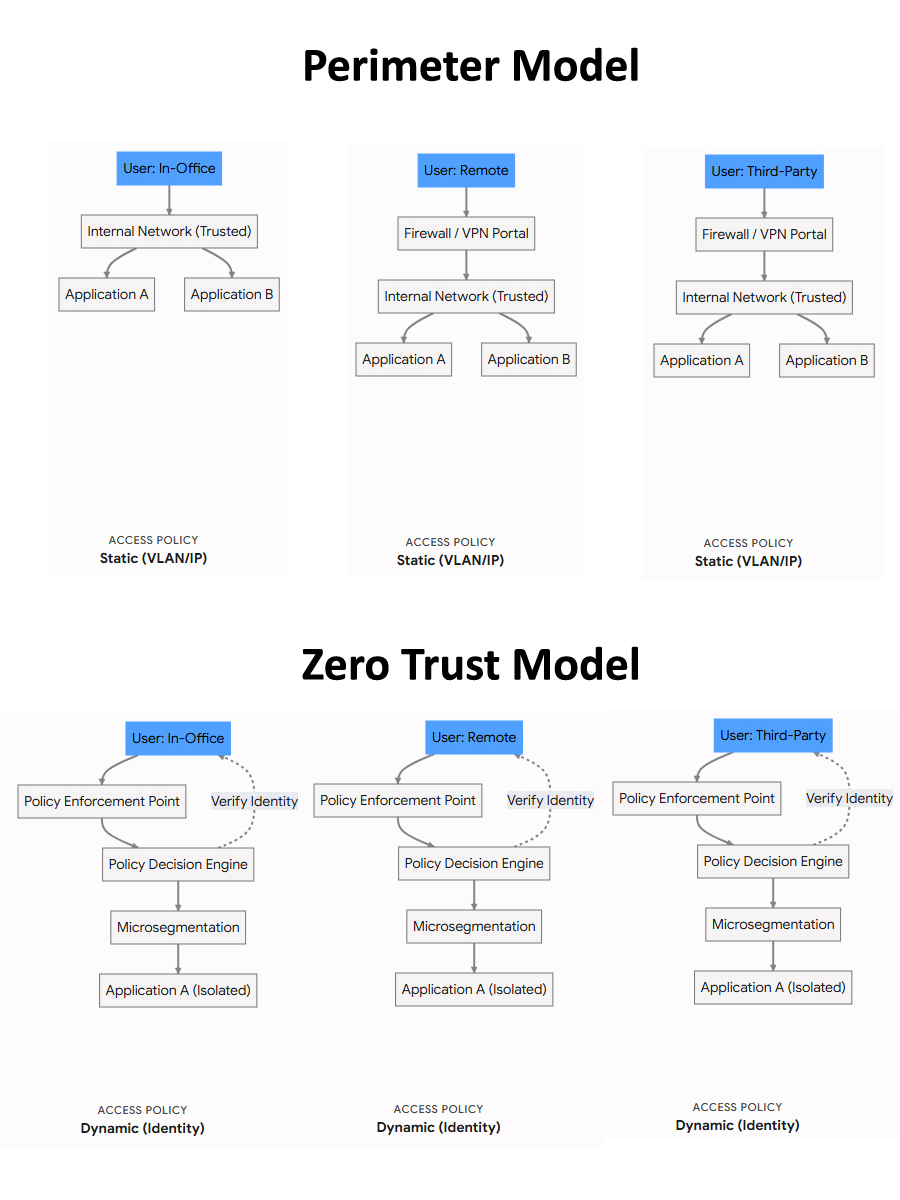
Key insight: In a traditional network, a compromised remote worker's laptop could give an attacker the keys to the entire kingdom. Under Zero Trust, that same attacker would hit a wall at every single application they tried to access.
What Exactly is Zero Trust?
Coined by Forrester Research analyst John Kindervag in 2010, Zero Trust isn't a single software product you can buy off the shelf. It is a strategic approach that mandates strict identity verification for every person and device trying to access resources on a private network, regardless of whether they are sitting inside the office or at a coffee shop.
In 2026, implicit trust is a liability. You can no longer assume that just because a user successfully logged in once, they are safe for the rest of the day.
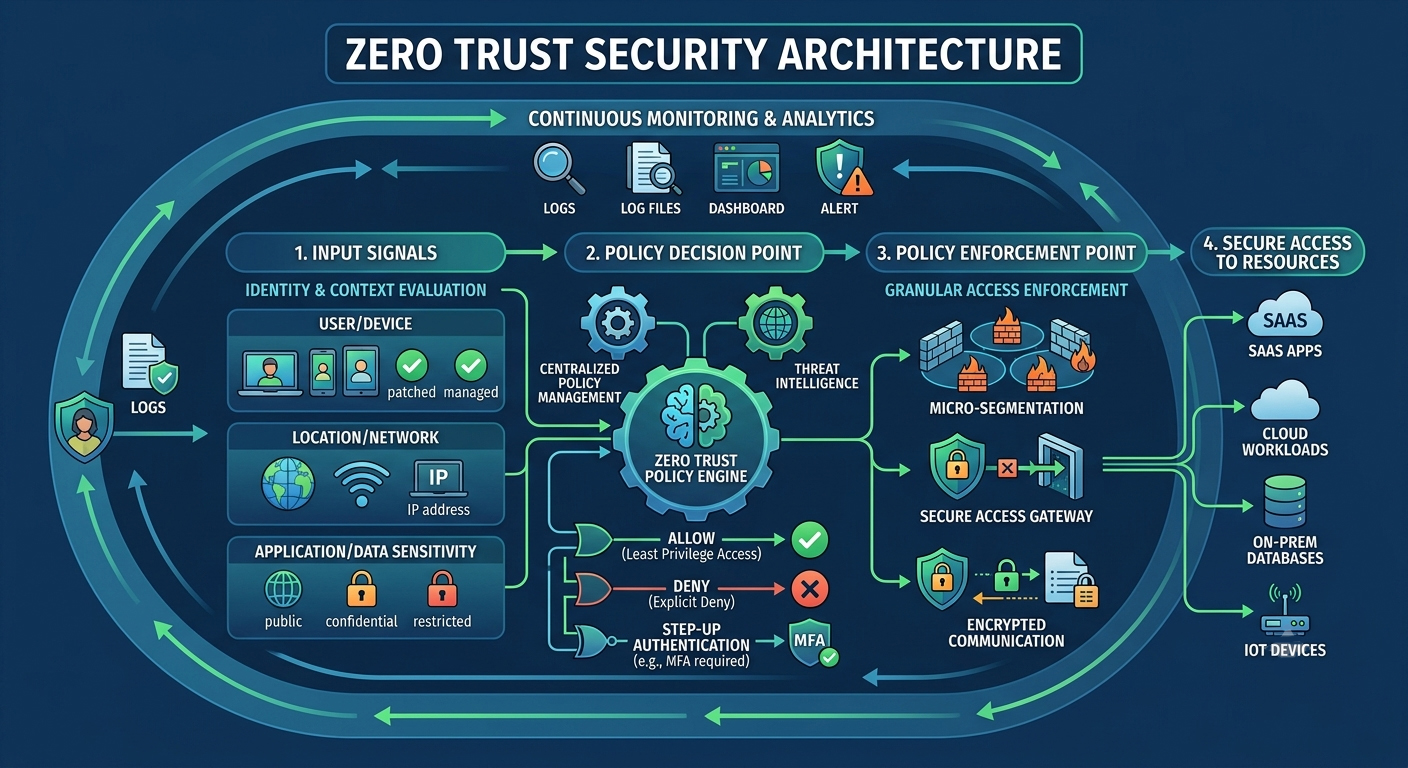
The 4 Core Pillars of Zero Trust
Transitioning to a Zero Trust architecture generally involves adhering to these core principles:
-
Assume Breach: Design your security posture as if attackers are already inside your network. This means treating all internal traffic with the same level of suspicion as external traffic and encrypting everything.
-
Verify Explicitly (Continuous Authentication): Trust is never permanent. Systems must constantly evaluate risk signals—like user identity, device health, location, and behavioral anomalies—before and during every session.
-
Least Privilege Access: Users and devices are given only the minimum permissions necessary to do their jobs. Think of it like a hotel key card: it gets you into the lobby and your specific room, but it won't open the kitchen, the manager's office, or anyone else's room.
-
Microsegmentation: Networks are divided into small, isolated zones. If an attacker manages to breach one segment, they are contained and cannot move laterally across the environment to access more sensitive data.
Why the Urgency Now?
The push for Zero Trust has accelerated rapidly. The rise of AI-driven attacks means threat actors can crack passwords and craft spear-phishing emails faster than ever. Furthermore, with multi-cloud environments and Software-as-a-Service (SaaS) applications dominating enterprise IT, the traditional network perimeter simply no longer exists.
Identity has become the new perimeter. By forcing continuous verification and severely limiting the "blast radius" of any potential breach, Zero Trust allows organizations to operate securely in a borderless digital world.