
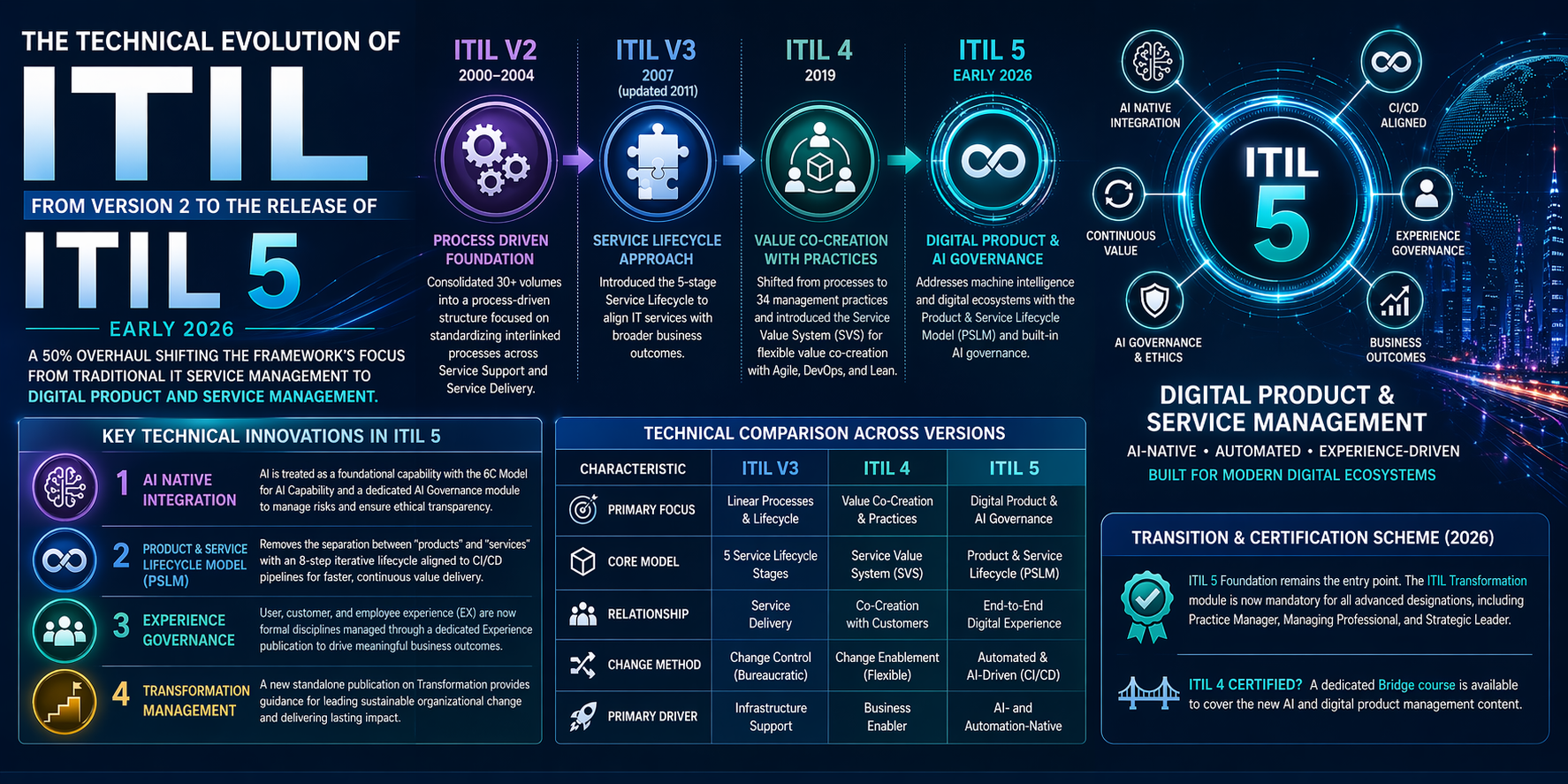
The following report details the technical development of the ITIL framework, culminating in the release of ITIL 5 in early 2026. This latest version represents a 50% overhaul of previous content, shifting the framework's focus from traditional IT service management to digital product and service management.
Chronological Development of the ITIL Framework
- ITIL V2 (2000–2004): This version consolidated the extensive 30+ volumes of V1 into a process-driven structure. It focused primarily on standardizing interlinked processes, organized into two core areas: Service Support (e.g., Incident and Change Management) and Service Delivery (e.g., Capacity and Availability Management).
- ITIL V3 (2007, updated 2011): V3 introduced the Service Lifecycle model, replacing individual process silos with a five-stage linear approach: Service Strategy, Service Design, Service Transition, Service Operation, and Continual Service Improvement (CSI). Its goal was to align IT services more closely with broader business outcomes.
- ITIL 4 (2019): This version shifted from "processes" to 34 management practices and introduced the Service Value System (SVS). It moved away from linear lifecycles to a more flexible model designed for co-creating value in environments utilizing Agile, DevOps, and Lean methodologies.
- ITIL 5 (2026): Launched in early 2026, this version addresses machine intelligence and complex digital ecosystems. It replaces the SVS with the Product and Service Lifecycle Model (PSLM), an eight-activity iterative lifecycle built specifically for modern digital product teams.
Key Technical Innovations in ITIL 5
- AI Native Integration: ITIL 5 treats artificial intelligence as a foundational capability rather than an optional tool. It introduces the 6C Model for AI Capability and a dedicated AI Governance extension module to handle the risks and ethical transparency of machine intelligence.
- Product and Service Lifecycle Model (PSLM): The framework officially removes the separation between "products" and "services," governing them through an integrated 8-step lifecycle designed to align with Continuous Integration and Continuous Delivery (CI/CD) pipelines.
- Experience Governance: User, customer, and employee experience (EX) are now formal disciplines managed through a dedicated Experience publication, moving metrics beyond simple technical uptime toward meaningful business outcomes.
- Transformation Management: A new standalone publication on Transformation provides specific guidance on leading sustainable organizational change, addressing a long-standing gap in previous versions.
Technical Comparison Across Versions
| Characteristic | ITIL V3 | ITIL 4 | ITIL 5 |
|---|---|---|---|
| Primary Focus | Linear Processes & Lifecycle | Value Co-Creation & Practices | Digital Product & AI Governance |
| Core Model | 5 Service Lifecycle Stages | Service Value System (SVS) | Product & Service Lifecycle (PSLM) |
| Relationship | Service Delivery | Co-Creation with Customers | End-to-End Digital Experience |
| Change Method | Change Control (Bureaucratic) | Change Enablement (Flexible) | Automated & AI-Driven (CI/CD) |
| Primary Driver | Infrastructure Support | Business Enabler | AI- and Automation-Native |
Transition and Certification Scheme (2026)
The certification path for ITIL 5 has been updated to reflect role-based competencies. While ITIL 5 Foundation remains the entry point, the ITIL Transformation module is now a mandatory requirement for all advanced designations, including Practice Manager, Managing Professional, and Strategic Leader. For those already holding ITIL 4 certifications, a specific Bridge course is available to cover the new AI and digital product management content.