
Introduction: When One Server Can Bring Down an Entire Business
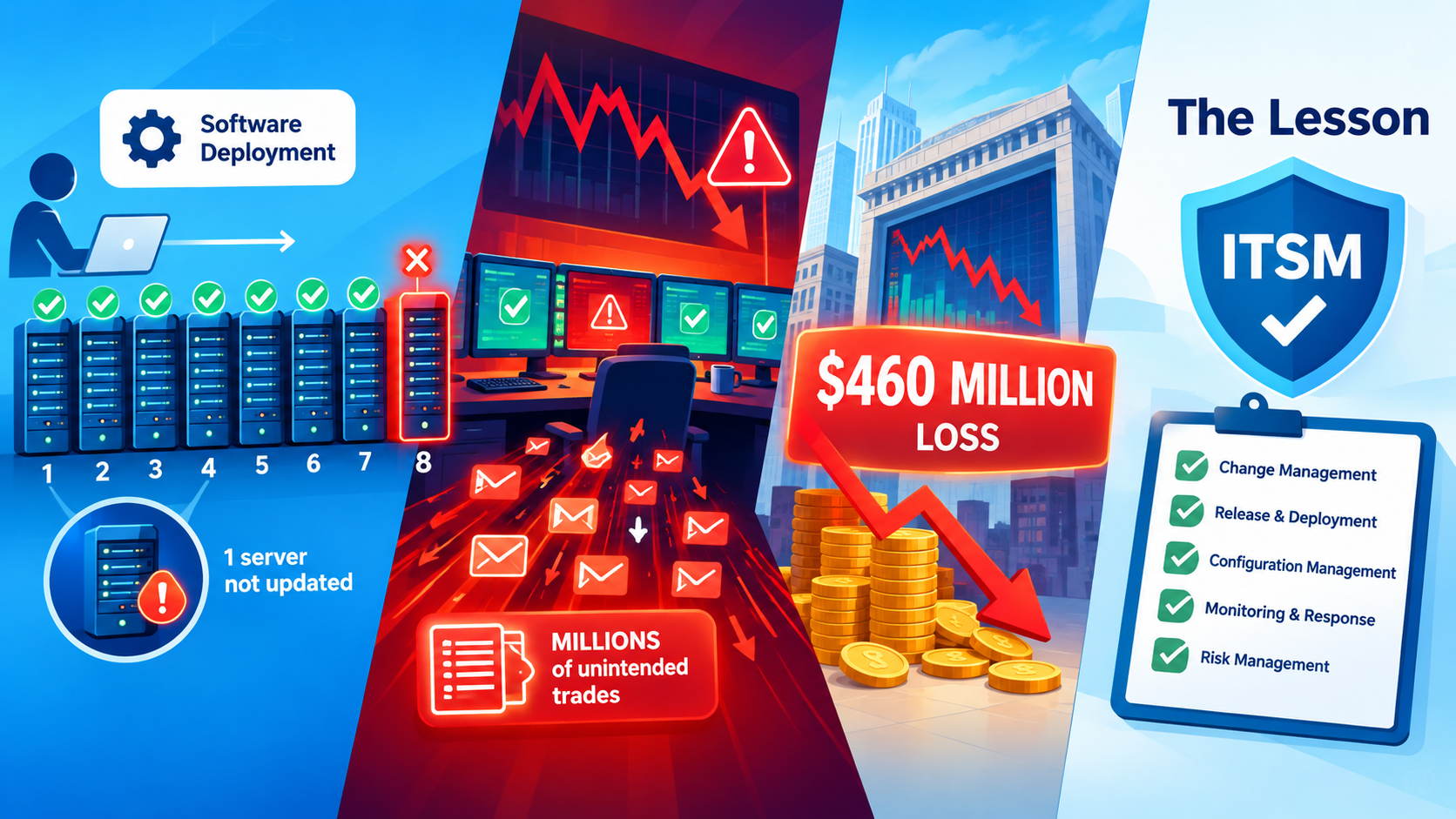
On August 1, 2012, Knight Capital Group, one of the major players in the US financial trading industry, experienced one of the most expensive software deployment failures in corporate history.
In approximately 45 minutes, a software malfunction caused the company to execute millions of unintended stock market transactions. The result was a financial loss exceeding $460 million, severely damaging the company's financial position and ultimately threatening its survival.
What makes this incident particularly remarkable is that the disaster originated from a seemingly straightforward IT operational mistake: a software update was deployed to seven out of eight servers, while the eighth server continued running an outdated version.
This incident remains an important case study in IT Service Management, particularly in Change Management, Release and Deployment Management, Configuration Management, IT Operations, and Risk Management.
1. What Happened?
Knight Capital was preparing to participate in the New York Stock Exchange's Retail Liquidity Program (RLP), which required modifications to its automated trading system, known as SMARS (Smart Market Access Routing System).
The company introduced new software functionality to support the program. The deployment process involved updating eight servers running the trading application.
However, something went wrong.
The deployment technician successfully installed the new software on seven servers but failed to update the eighth server. Consequently:
-
Seven servers were running the new software.
-
One server continued running the old software.
-
The old version contained a dormant functionality called "Power Peg," which had been discontinued years earlier but had not been removed from the system.
-
The new software reused a system flag that had previously activated the Power Peg functionality.
When the trading system started processing orders on August 1, 2012, the seven updated servers operated correctly. However, when certain orders reached the eighth server, the repurposed flag unintentionally activated the old Power Peg functionality.
The outdated code was also defective because an earlier modification, made in 2005, had moved a critical cumulative quantity function elsewhere in the program. As a result, the old functionality no longer correctly recognized when an order had been filled.
The server began generating and submitting repeated trading orders without properly considering the executions already completed.
2. The Financial Impact: 45 Minutes of Chaos
The consequences were extraordinary.
According to the US Securities and Exchange Commission (SEC):
-
212: Customer orders that triggered the malfunction.
-
4 million: Executions generated by the malfunctioning system.
-
154: Different stocks involved.
-
397 million+: Shares traded.
-
45 minutes: Approximate duration of the incident.
-
$460 million+: Financial loss suffered by Knight Capital.
The erroneous transactions also affected market prices. In several stocks, Knight's trading activity represented a substantial proportion of the total trading volume and contributed to significant price movements.
The incident was not simply an IT failure. It became a major financial, operational, and reputational crisis.
3. Why Did It Happen? Beyond the Outdated Server
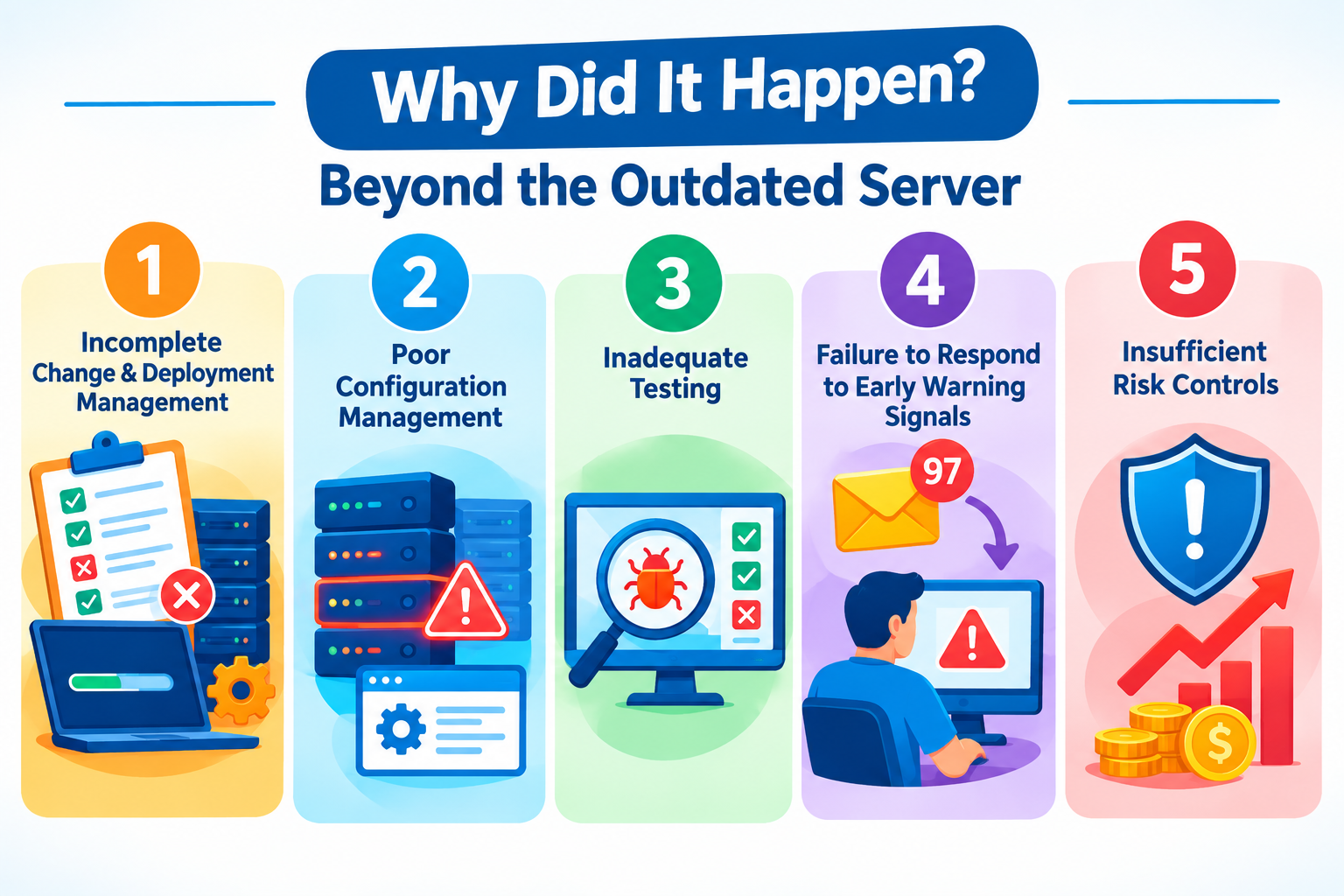
It would be easy to attribute the disaster entirely to one technician forgetting to update one server. However, the SEC investigation revealed several underlying organizational and IT management weaknesses.
A. Incomplete Change and Deployment Management
Knight Capital did not have adequate controls to verify that the software had been deployed consistently across all eight servers. There was no mandatory independent second-person review of the deployment, and no written procedure requiring such verification.
B. Poor Configuration Management
The company had no effective mechanism to ensure that all servers running the same application were operating with the same software version and configuration. The presence of outdated, dormant functionality in the production environment also demonstrated weaknesses in managing legacy components.
C. Inadequate Testing
The old Power Peg functionality had not been retested after its internal code structure was modified in 2005. The new deployment process also failed to identify the potential interaction between the new functionality and the dormant legacy code.
D. Failure to Respond to Early Warning Signals
Perhaps even more surprising, Knight Capital's internal systems generated 97 automated email messages before the market opened. These messages referenced the Power Peg functionality and provided an opportunity to investigate the problem before trading began. However, employees did not recognize these messages as critical alerts, and no effective response followed.
E. Insufficient Risk Controls
The company lacked adequate automated safeguards to prevent abnormal order volumes and excessive financial exposure. Consequently, the malfunction continued generating and executing orders until the trading system was eventually stopped.
4. What Can ITSM Professionals Learn from This Incident?
The Knight Capital incident illustrates that ITSM is not merely about documenting processes or ensuring that IT services are available. It is fundamentally about controlling operational risks and protecting business value.
Several ITSM practices could have helped prevent or significantly reduce the impact of this disaster.
| ITSM Practice | Lesson from Knight Capital |
|---|---|
| Change Enablement (Change Management) | Every production change must have documented approval, implementation controls, validation, and rollback arrangements. |
| Release and Deployment Management | Software deployment must be verified across every target server, not just a sample of the infrastructure. |
| Service Configuration Management | Configuration records must accurately reflect actual production environments, including software versions and legacy components. |
| IT Asset Management | Legacy software and unused functionality must be identified, assessed, and appropriately retired. |
| Service Validation and Testing | Testing must cover deployment consistency, backward compatibility, integration, and potential failure scenarios. |
| Monitoring and Event Management | Critical system warnings must be detected, prioritized, escalated, and acted upon. |
| Incident Management | Organizations need clear incident response procedures and the ability to stop abnormal operations quickly. |
| Risk Management | Financial and operational safeguards should limit the impact of technology failures, even when preventive controls fail. |
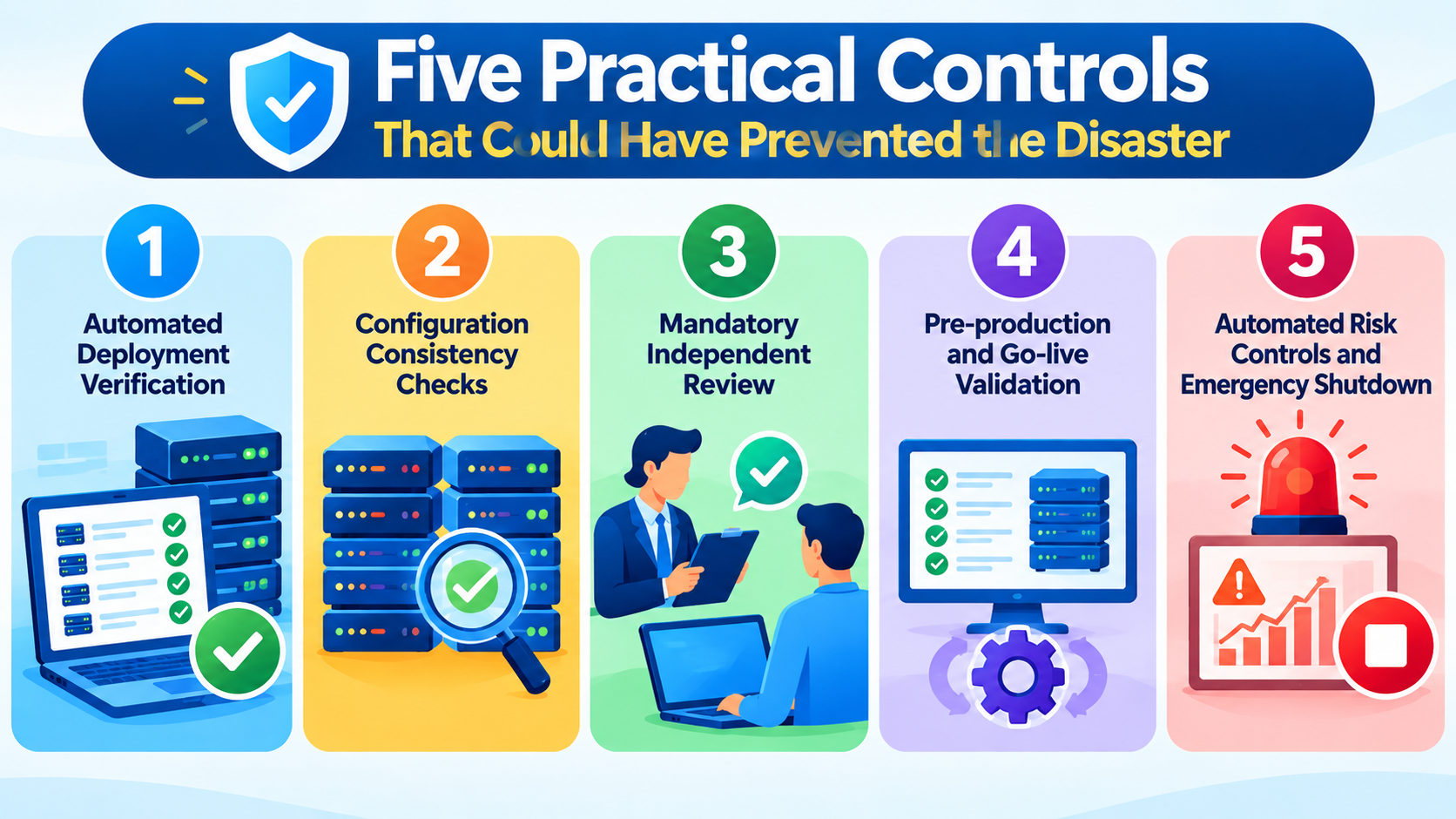
5. Five Practical Controls That Could Have Prevented the Disaster
Beyond the ITSM processes themselves, this incident highlights five particularly important technical and operational controls:
-
Automated Deployment Verification: Ensure that every target server receives the approved software version, with automated comparison and confirmation before deployment is declared complete.
-
Configuration Consistency Checks: Continuously identify discrepancies between servers running the same application, particularly in production environments.
-
Mandatory Independent Review: Require a second authorized person to verify critical production deployments, especially in business-critical systems.
-
Pre-production and Go-live Validation: Test the complete production configuration, including legacy functionality, integration points, and realistic failure scenarios.
-
Automated Risk Controls and Emergency Shutdown: Establish thresholds that detect abnormal transaction volumes and automatically stop or isolate malfunctioning components before losses escalate.
6. The Business Lesson: IT Failures Are Business Failures
Knight Capital's experience demonstrates an important reality: the financial consequences of IT failures are not necessarily proportional to the technical complexity of the underlying problem.
A single outdated server, a forgotten piece of legacy code, an incomplete deployment, and inadequate operational controls combined to create a loss exceeding $460 million.
The incident also demonstrates why organizations should not treat ITSM practices as administrative overhead or bureaucratic requirements. Properly implemented ITSM practices are essential business controls that protect revenue, assets, customers, reputation, and business continuity.
Conclusion: Eight Servers, One Missing Update, $460 Million Lost
The Knight Capital incident is a powerful reminder that production environments must be managed as integrated systems rather than collections of independent technical components.
Updating seven servers out of eight is not a successful deployment. Receiving an alert is not effective monitoring if nobody acts on it. Having a change procedure is not sufficient if it does not include verification and risk controls.
Ultimately, the lesson is simple:
In critical IT environments, consistency is not optional, deployment verification is not a formality, and operational controls are not just technical safeguards. They are business survival mechanisms.
The Knight Capital disaster should remain a reference case for every ITSM professional, IT manager, change manager, DevOps engineer, and business executive responsible for the reliability and governance of technology-enabled operations.
References and Further Reading
-
US Securities and Exchange Commission (SEC) – Knight Capital Americas LLC: SEC Administrative Order, October 16, 2013. The official investigation and detailed technical findings.
-
SEC Press Release – SEC Charges Knight Capital With Violations of Market Access Rule.
-
Knight Capital Group – August 2, 2012 Company Statement.
This article is based primarily on the SEC's official investigation and findings.