
Managing Multiple Providers Without Losing Control
As organizations continue their digital transformation journeys, IT service delivery has become increasingly complex. Few enterprises today rely on a single technology supplier. Instead, they consume services from cloud providers, managed service providers, software vendors, telecommunications companies, cybersecurity partners, and internal IT teams simultaneously.
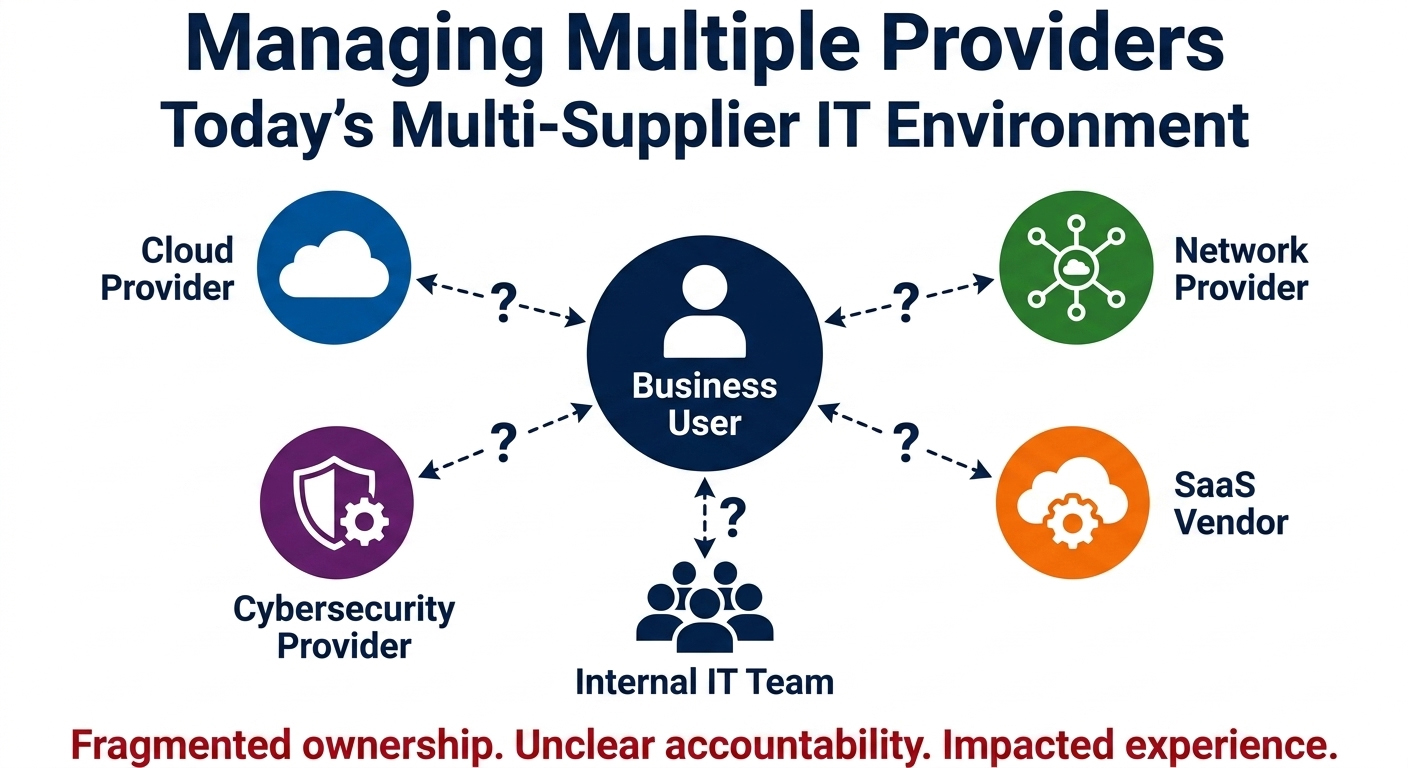 While this multi-supplier environment offers flexibility and access to specialized expertise, it also introduces significant challenges:
-
Who is accountable when a service fails?
-
How are responsibilities coordinated across suppliers?
-
How can service quality be measured consistently?
-
How can organizations prevent suppliers from operating in silos?
These challenges have driven the emergence of Service Integration and Management (SIAM) as one of the most important disciplines in modern IT Service Management (ITSM).
What is SIAM?
Service Integration and Management (SIAM) is a management framework designed to coordinate, govern, and integrate services delivered by multiple providers into a single, coherent service ecosystem.
Rather than replacing existing ITSM practices, SIAM acts as a governance and orchestration layer that ensures all service providers work together toward common business outcomes.
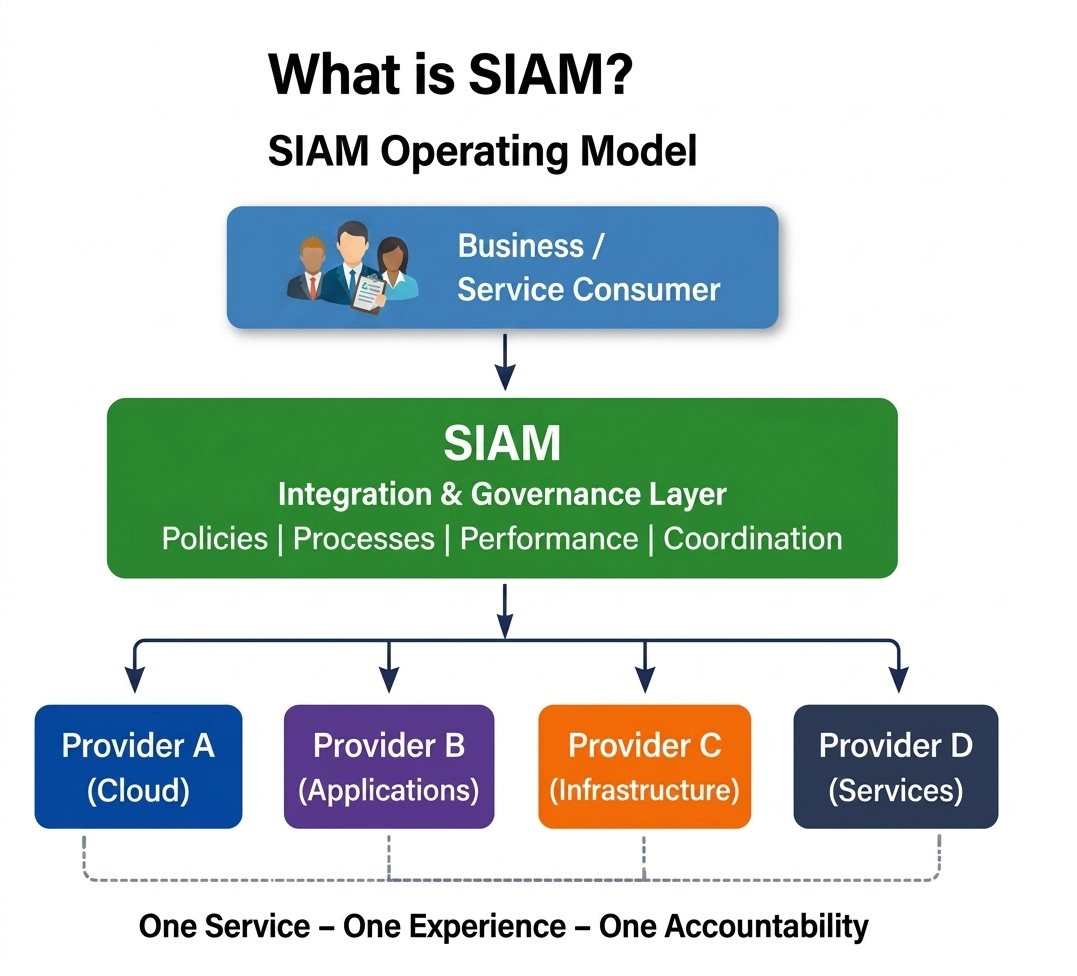 The primary objectives of SIAM include:
-
End-to-end service accountability
-
Supplier coordination
-
Consistent service management processes
-
Unified performance measurement
-
Improved customer experience
-
Enhanced business value realization
In a SIAM model, the focus shifts from managing individual suppliers to managing the complete service landscape.
Why SIAM Matters Today
Historically, organizations often outsourced large portions of IT operations to a single strategic vendor. Management complexity was relatively straightforward because accountability rested with one provider.
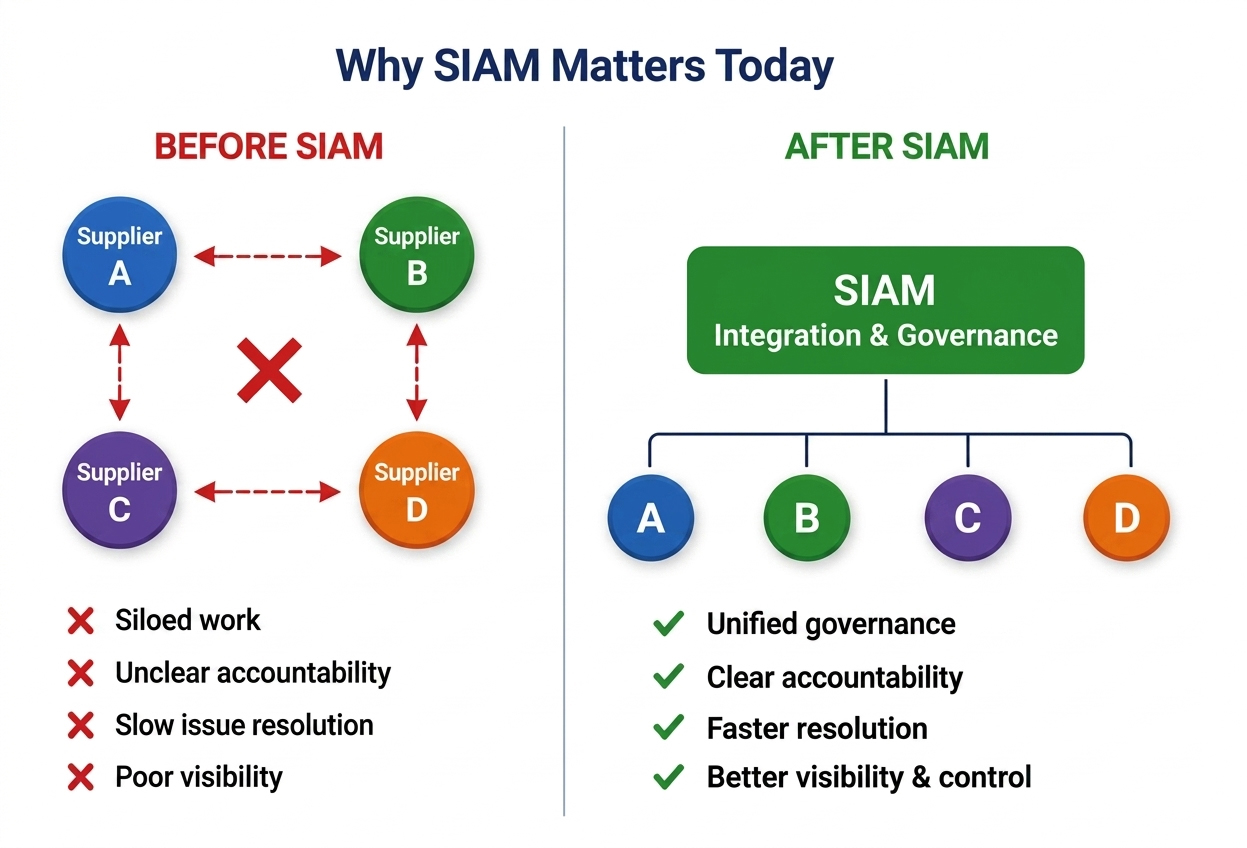 Today, however, organizations typically consume:
-
Cloud infrastructure from one provider
-
Security services from another
-
Application support from several vendors
-
Network services from telecommunications partners
-
Internal business technology services
Without integration, service delivery becomes fragmented.
A business user does not care whether a problem originates from the cloud provider, network supplier, software vendor, or internal team. They simply expect the service to work.
SIAM establishes governance mechanisms that enable multiple providers to collaborate effectively while maintaining clear accountability.
Core Components of SIAM
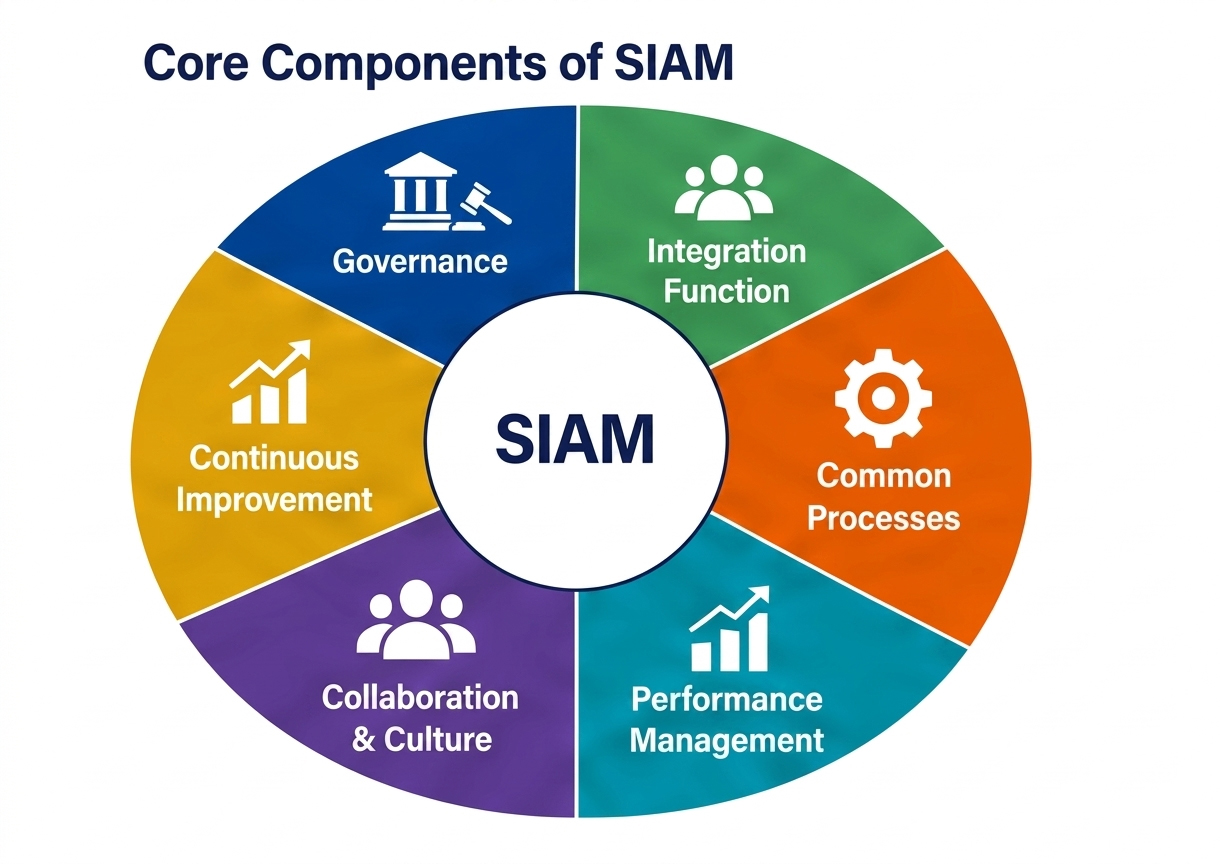
A mature SIAM implementation generally includes:
Governance
Defines decision-making authority, accountability structures, policies, and performance oversight.
Service Integration Function
Acts as the coordinating body that manages interactions among suppliers and ensures adherence to agreed processes.
 Common Processes
Standardized processes for:
-
Incident Management
-
Problem Management
-
Change Enablement
-
Service Request Management
-
Service Level Management
Performance Management
Common metrics and reporting frameworks ensure that providers are evaluated against shared objectives rather than isolated contractual targets.
Collaboration and Culture
Perhaps the most overlooked element of SIAM is fostering a collaborative culture among suppliers who may otherwise compete with one another.
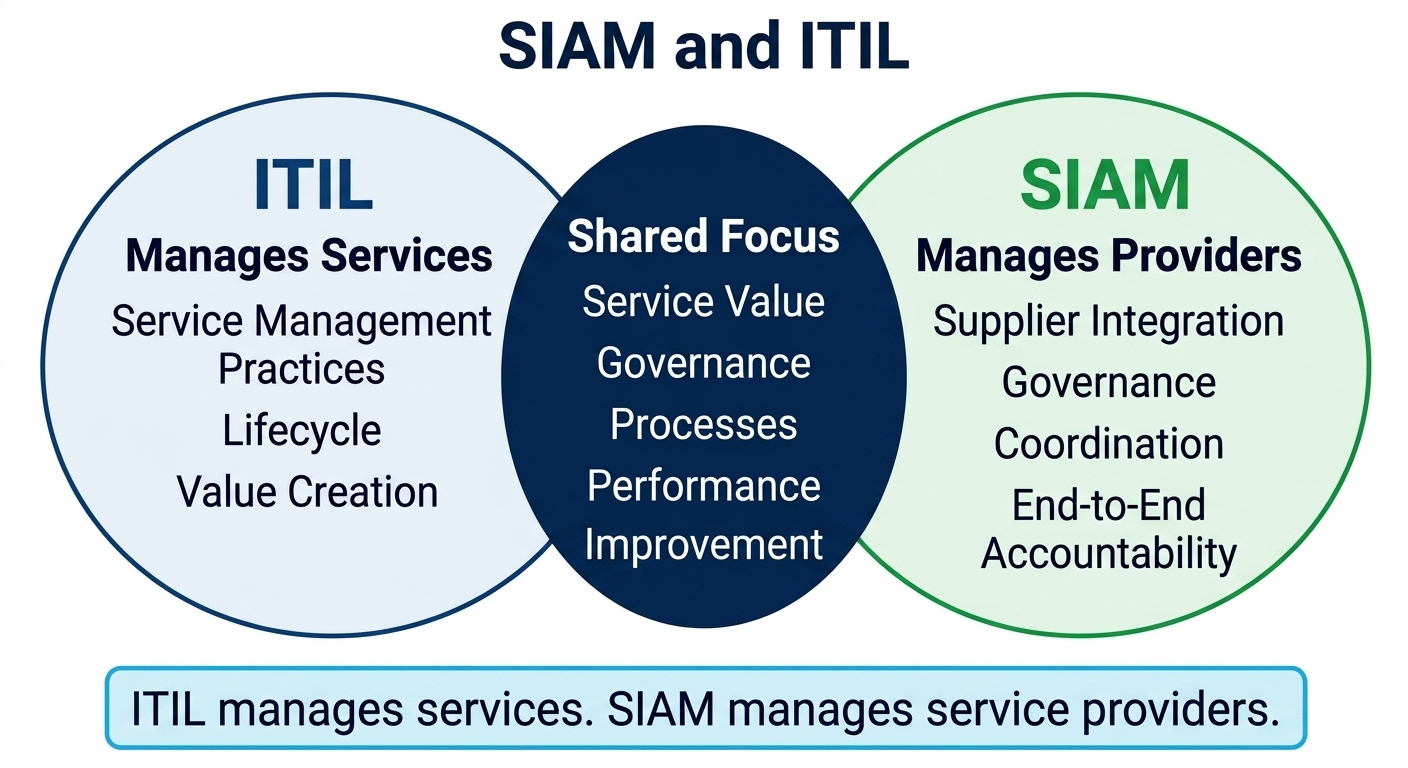
SIAM and ITIL: Competition or Complement?
One of the most common misconceptions is that SIAM competes with ITIL.
In reality, SIAM and ITIL address different challenges.
ITIL Focus
The current version of ITIL focuses on:
-
Service value creation
-
Service management practices
-
Governance
-
Continuous improvement
-
Customer outcomes
ITIL defines how services should be managed.
SIAM Focus
SIAM focuses on:
-
Multi-provider coordination
-
Cross-supplier governance
-
End-to-end accountability
-
Service integration
SIAM defines how multiple organizations collaborate to deliver those services.
The Relationship
A useful analogy is:
ITIL manages services.
SIAM manages service providers.
Organizations frequently use ITIL practices as the operational foundation while applying SIAM governance across suppliers.
Rather than replacing ITIL, SIAM extends its effectiveness in complex sourcing environments.
SIAM vs COBIT
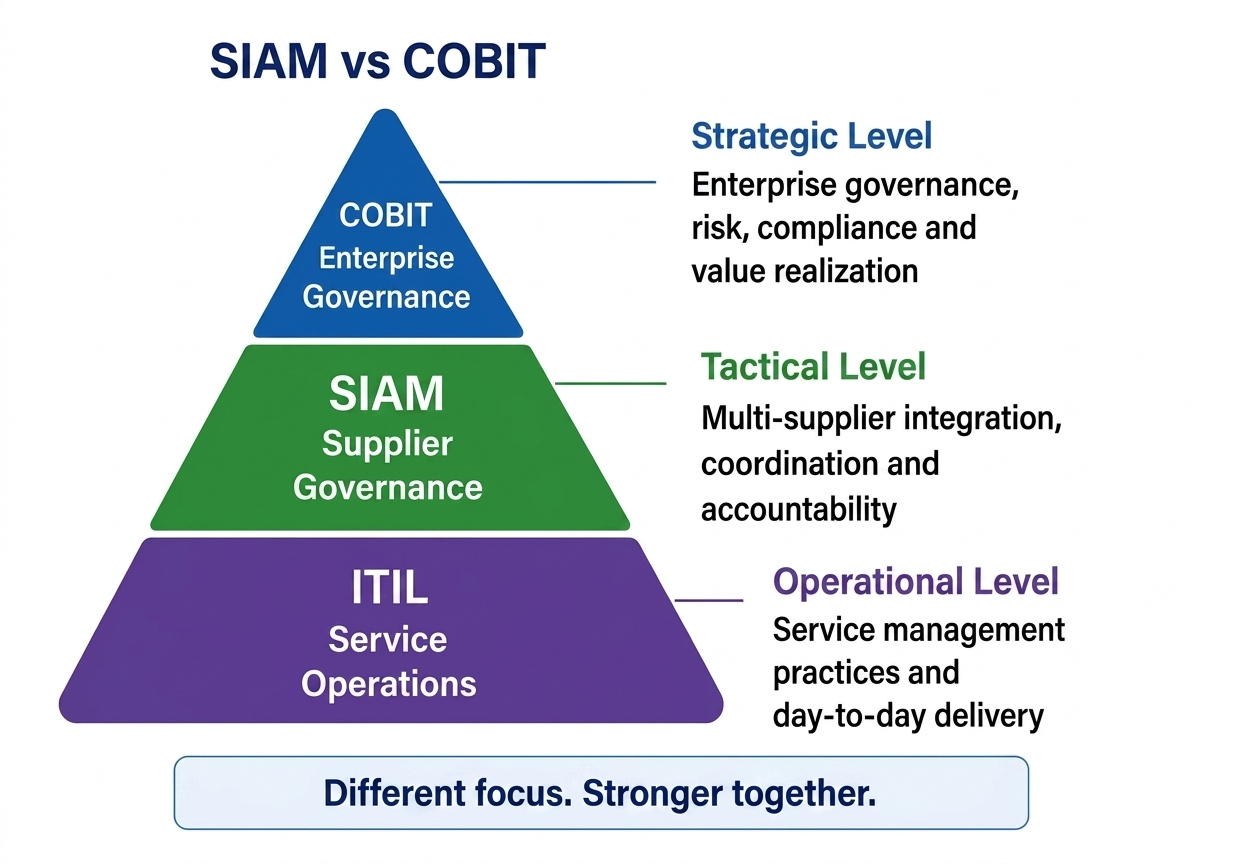
Another framework frequently discussed alongside SIAM is COBIT.
COBIT Focus
COBIT focuses on:
-
Enterprise governance
-
Risk management
-
Compliance
-
Strategic alignment
-
Value realization
COBIT operates primarily at the executive and governance level.
SIAM Focus
SIAM operates at the service delivery and supplier management level.
Integration Opportunity
A mature organization may use:
-
COBIT for governance and strategic control
-
SIAM for supplier integration
-
ITIL for operational service management
In this model, the frameworks complement rather than compete with one another.
SIAM vs ISO/IEC 20000
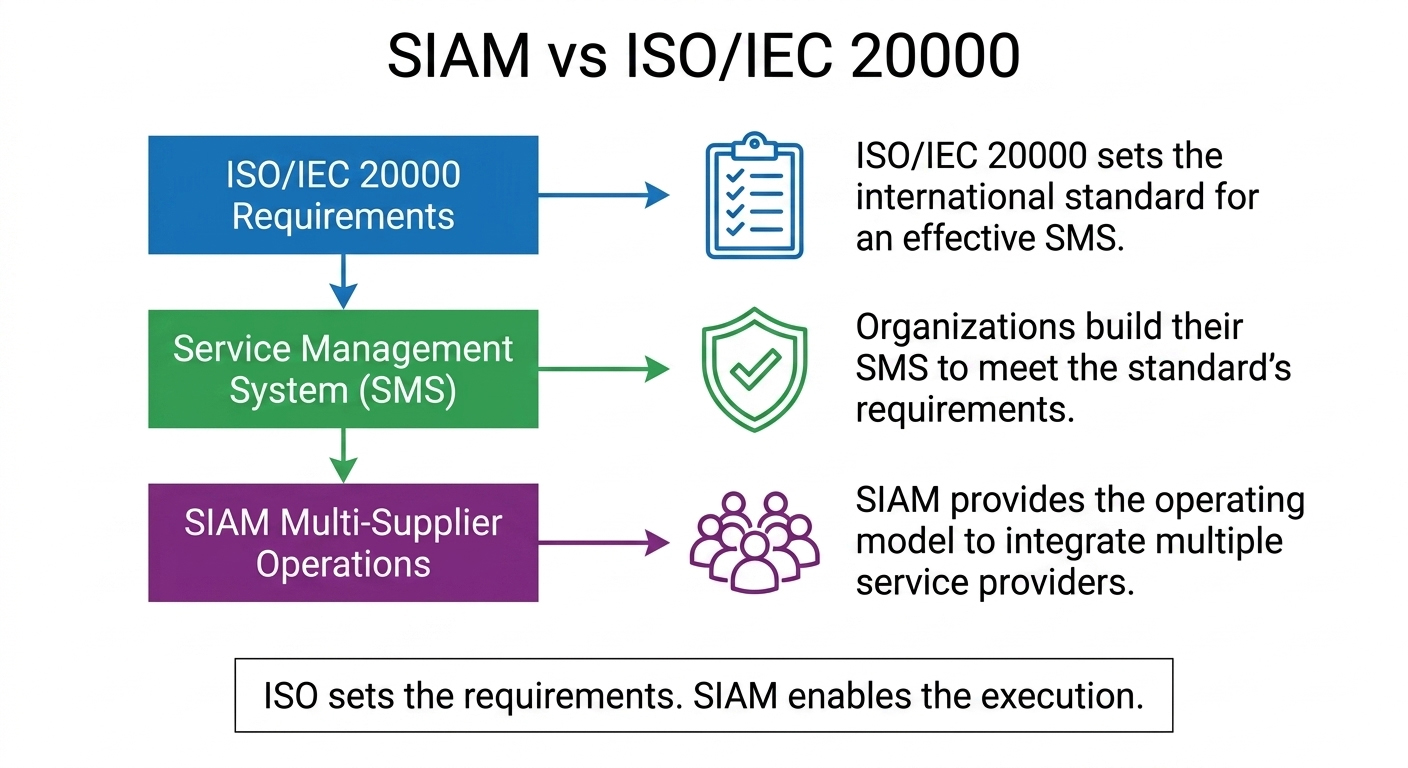 ISO/IEC 20000 is an international standard for IT Service Management.
ISO/IEC 20000 Focus
The standard specifies requirements for establishing, implementing, maintaining, and continually improving a Service Management System (SMS).
SIAM Focus
SIAM does not function as a certification standard. Instead, it provides an operating model for coordinating multiple service providers.
Integration Opportunity
Organizations can implement SIAM while maintaining compliance with ISO/IEC 20000 requirements, especially in areas such as supplier management, governance, and service control.
SIAM vs DevOps
At first glance, SIAM and DevOps may appear to pursue different goals.
DevOps Focus
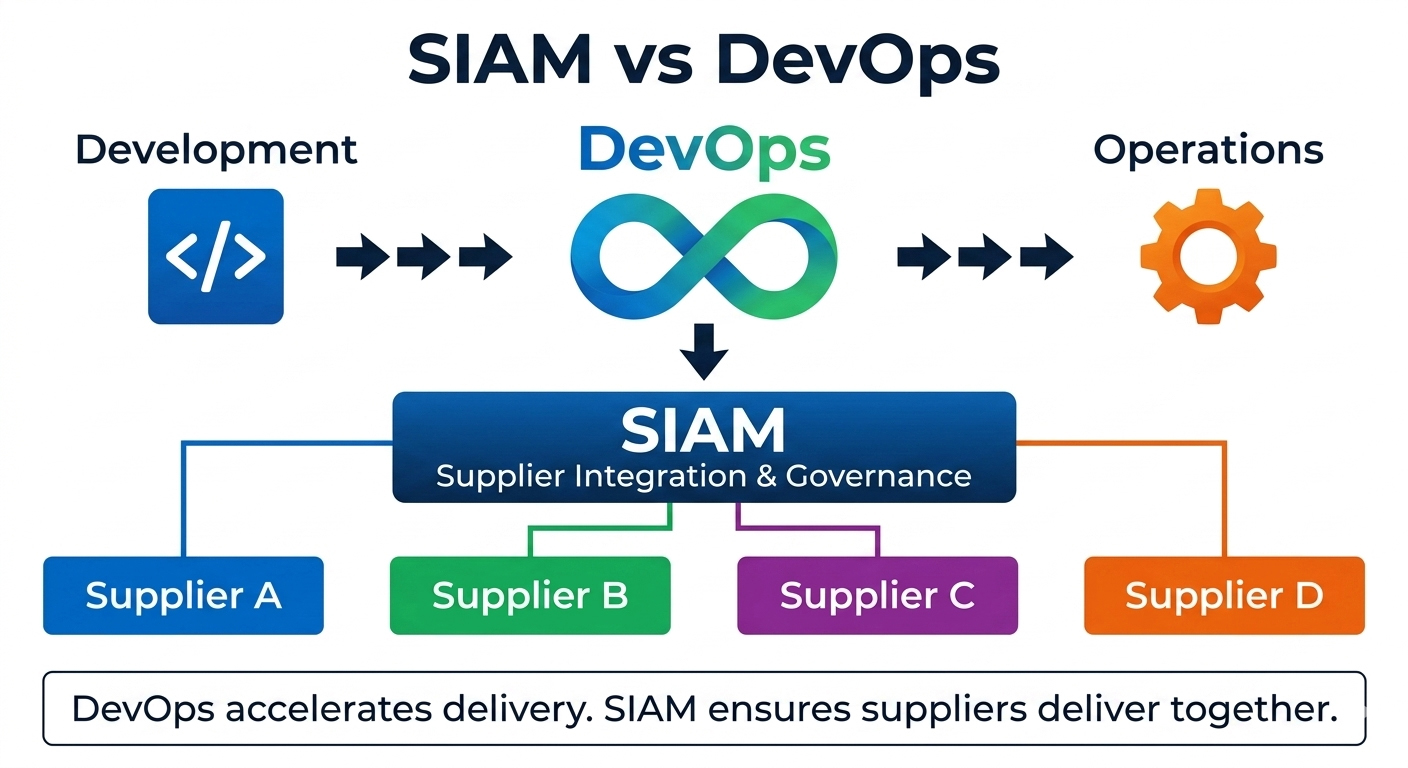 DevOps emphasizes:
-
Faster delivery
-
Automation
-
Collaboration between development and operations
-
Continuous integration and deployment
SIAM Focus
SIAM emphasizes:
-
Supplier coordination
-
Governance
-
Service accountability
-
Operational integration
Integration Opportunity
In large enterprises, multiple suppliers may participate in DevOps pipelines. SIAM provides the governance structure necessary to ensure those suppliers collaborate effectively while maintaining service quality and accountability.
Common Criticisms of SIAM
Like any framework, SIAM is not without criticism.
"SIAM Adds Bureaucracy"
Poorly implemented SIAM can create additional governance layers and slow decision-making.
However, mature implementations focus on enabling collaboration rather than creating administrative overhead.
"Suppliers Already Manage Themselves"
Individual suppliers may optimize their own performance, but business outcomes typically require coordination across multiple providers.
SIAM addresses the gaps that exist between suppliers.
"Cloud Providers Eliminate the Need for SIAM"
Cloud adoption often increases supplier diversity rather than reducing it.
Organizations frequently use multiple cloud platforms, SaaS solutions, cybersecurity vendors, and managed service providers simultaneously. This complexity strengthens the business case for SIAM.
Key Benefits of SIAM
Organizations that successfully adopt SIAM often achieve:
-
Improved end-to-end service quality
-
Better supplier accountability
-
Faster issue resolution
-
Reduced duplication of effort
-
Enhanced governance and compliance
-
Greater business transparency
-
Improved customer experience
Most importantly, SIAM shifts organizational focus away from supplier boundaries and toward business outcomes.
The Future of SIAM
As organizations continue to embrace cloud computing, artificial intelligence, managed services, and global sourcing models, the number of service providers involved in delivering business services will continue to grow.
This trend makes service integration increasingly important.
Rather than viewing SIAM as a competing framework, organizations should recognize it as a complementary capability that fills a critical gap in traditional IT Service Management approaches.
The future of ITSM is not simply about managing services more effectively—it is about managing increasingly complex ecosystems of providers that collectively deliver those services.
SIAM provides the structure, governance, and integration necessary to make that possible.
Conclusion
SIAM has emerged as a practical response to the realities of modern IT sourcing. While frameworks such as ITIL, COBIT, ISO/IEC 20000, and DevOps each address specific aspects of service management and governance, SIAM focuses on a challenge that none of them fully solve: coordinating multiple service providers as a unified service ecosystem.
Organizations should not view SIAM as a replacement for existing frameworks. Instead, its greatest value comes from integrating with them, creating a comprehensive operating model that combines governance, service management, supplier coordination, and business value delivery.
In a world increasingly dependent on complex digital supply chains, SIAM may well become the defining capability that separates high-performing service organizations from the rest.