
Introduction
Data centers are the backbone of today's digital economy. They host the servers, storage systems, networking infrastructure, and applications that support critical business operations, cloud services, financial transactions, healthcare systems, and government platforms. As organizations become increasingly dependent on digital services, protecting these facilities from physical threats has become just as important as defending them against cyberattacks.
While cybersecurity measures such as firewalls, encryption, and intrusion detection systems protect digital assets, physical security safeguards the infrastructure on which these technologies depend. An unauthorized person gaining access to a server room, a malicious insider tampering with equipment, or a coordinated physical intrusion can cause service disruptions, data breaches, financial losses, and serious reputational damage.
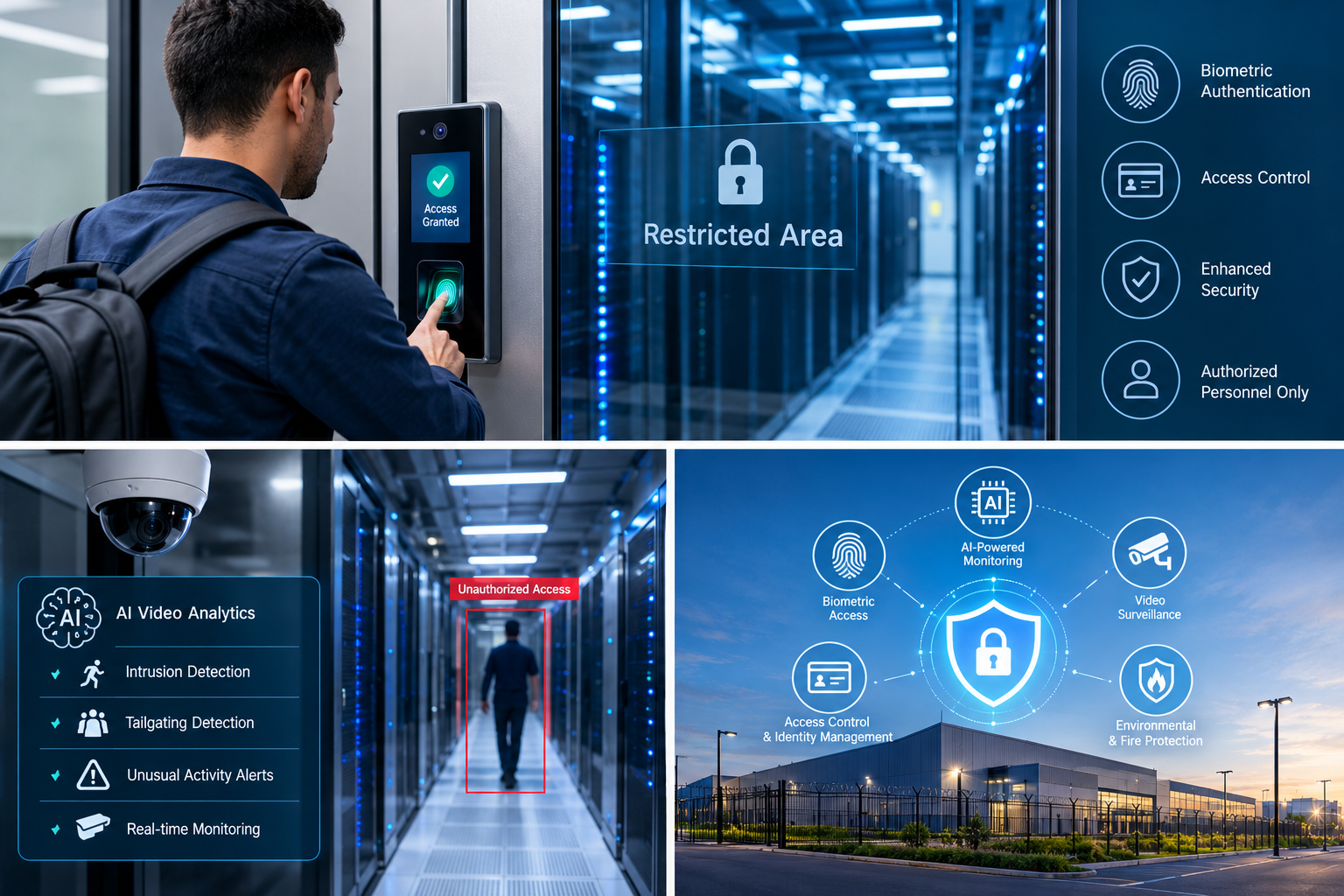
Traditional physical security measures remain essential, but the landscape is evolving. Biometric authentication, artificial intelligence (AI), intelligent video surveillance, automated access management, and integrated security platforms are transforming how data centers detect, prevent, and respond to physical threats.
This article explores the core principles of data center physical security, examines emerging technologies, and outlines practical recommendations for building a resilient security strategy.
Why Physical Security Matters in Data Centers
Physical security protects people, facilities, equipment, information, and service availability against unauthorized access, theft, sabotage, and environmental hazards.
Unlike many office environments, data centers contain concentrated computing resources and critical infrastructure. A single compromised access point or damaged component can affect multiple customers, business units, or essential services.
Key physical security risks include:
-
Unauthorized access: Intruders entering restricted areas to steal equipment, access sensitive information, or disrupt operations.
-
Insider threats: Employees, contractors, or service providers misusing legitimate access privileges.
-
Equipment theft and tampering: Removal, modification, or damage to servers, storage devices, network equipment, and cabling.
-
Sabotage and vandalism: Deliberate actions intended to interrupt operations or destroy infrastructure.
-
Environmental incidents: Fire, flooding, overheating, smoke, and other hazards that threaten equipment and personnel.
-
Supply chain and maintenance risks: Unauthorized access or manipulation during equipment delivery, installation, repair, and disposal.
Effective physical security must address these risks through multiple, complementary layers rather than relying on a single protective technology.
The Foundations of Data Center Physical Security
Perimeter Security
The first layer of protection begins outside the data center building. Its purpose is to deter unauthorized entry, detect suspicious activity, and control movement around the facility.
Common measures include perimeter fencing, reinforced barriers, vehicle access controls, security lighting, guard patrols, monitored gates, and surveillance cameras.
Modern facilities may also use vehicle identification systems, license plate recognition, and automated alerts to identify vehicles that do not match approved access records.
Perimeter controls should be designed according to the facility's risk profile, geographical location, surrounding environment, and potential threat scenarios.
Layered Access Control
Once an individual reaches the facility, access should become progressively more restrictive.
A typical data center may have separate security zones for the reception area, administrative offices, operational areas, network rooms, server halls, and individual cages or racks.
Each zone should have clearly defined authorization requirements. A visitor permitted to enter the building should not automatically be allowed to access the server floor, and a technician authorized to maintain one customer's equipment should not necessarily have access to another customer's systems.
Access control mechanisms may include:
-
Electronic access cards and smart badges.
-
PIN codes and personal identification numbers.
-
Biometric authentication.
-
Mantraps and controlled-entry vestibules.
-
Anti-tailgating systems.
-
Individual rack and cabinet locks.
The objective is to apply the principle of least privilege to physical access: individuals should receive only the access necessary to perform their assigned responsibilities.
Video Surveillance and Security Monitoring
Closed-circuit television (CCTV) remains a fundamental component of data center security. Cameras monitor entrances, exits, loading bays, corridors, server halls, and other sensitive areas.
However, modern surveillance is moving beyond simply recording footage for later investigation. Intelligent cameras and video analytics can identify unusual activity, detect entry into restricted areas, recognize suspicious movement patterns, and alert security personnel to potential incidents.
Surveillance systems should provide adequate coverage, appropriate image quality, secure recording storage, synchronized timestamps, and retention periods aligned with operational needs and applicable privacy requirements.
Security Personnel and Operational Procedures
Technology alone cannot guarantee effective security. Trained security personnel remain essential for monitoring alerts, verifying identities, managing visitors, responding to incidents, and enforcing access policies.
Documented procedures should cover visitor registration, escort requirements, lost badges, emergency evacuation, suspicious activity, equipment deliveries, maintenance visits, and incident escalation.
Regular training and realistic security exercises help ensure that personnel can respond effectively when controls fail or unexpected situations arise.
Biometric Security: Verifying Identity with Greater Confidence
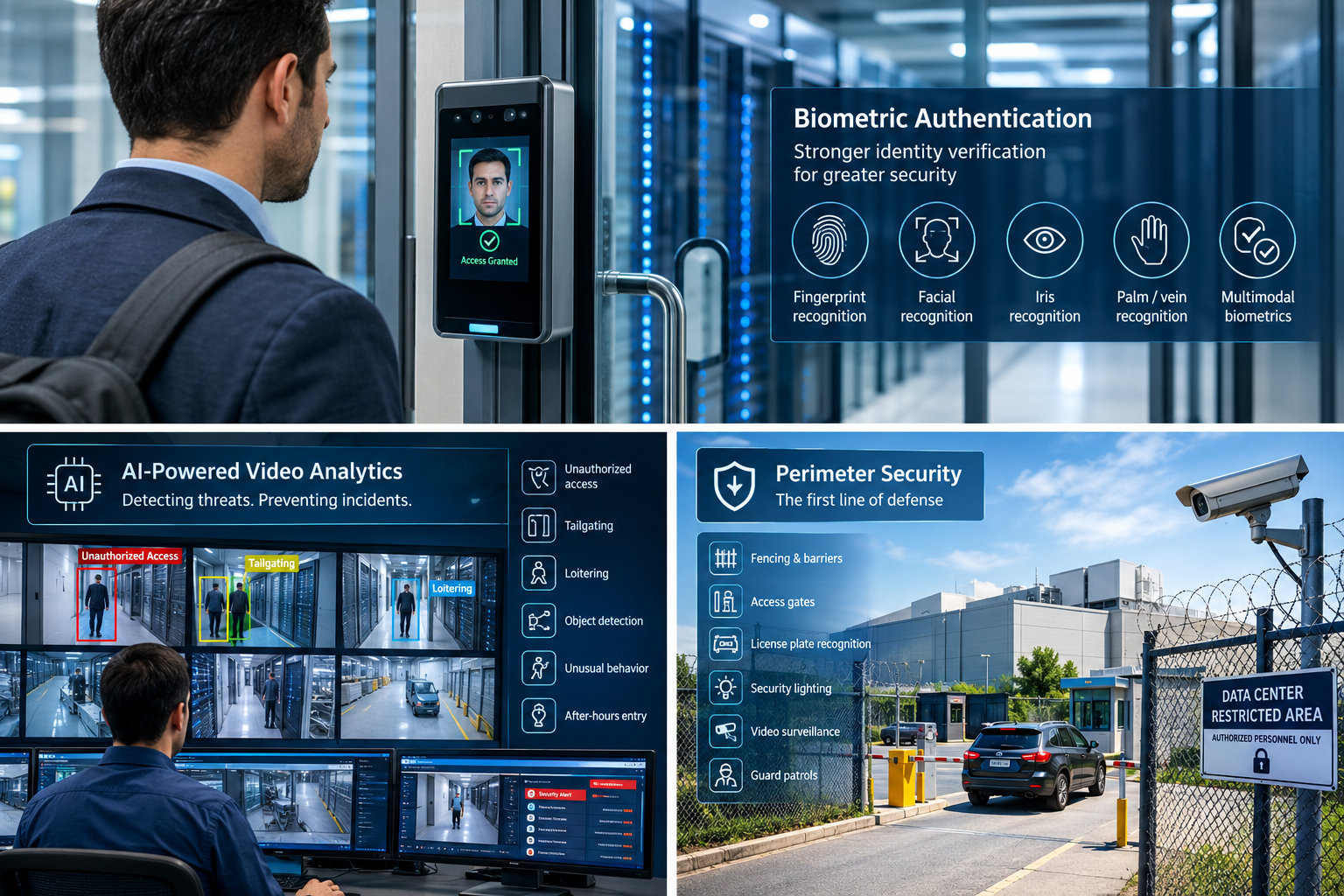
One of the most significant developments in physical access control is the growing adoption of biometric authentication.
Unlike conventional access cards or PINs, which can be shared, stolen, or forgotten, biometric systems verify an individual's identity using distinctive physical or behavioral characteristics.
Common biometric technologies include:
-
Fingerprint recognition: Verifies identity using fingerprint patterns and is often used at controlled doors.
-
Facial recognition: Compares facial characteristics against an authorized identity record, sometimes with liveness detection to reduce spoofing attempts.
-
Iris recognition: Uses distinctive patterns in the iris and can provide high-accuracy identity verification in appropriately designed systems.
-
Palm or vein recognition: Uses palm characteristics or underlying vein patterns for identity verification in specialized access-control applications.
-
Multimodal biometrics: Combines two or more biometric methods to improve assurance or accommodate different operating conditions.
How biometrics can improve data center security
Biometric authentication can reduce credential sharing, strengthen identity verification, and help ensure that the person entering a restricted area is the person authorized to do so.
For high-security zones, a facility may combine a smart card with a biometric check. This adds a second factor to the authentication process and can make unauthorized access more difficult.
Biometric systems can also integrate with access-management platforms to maintain time-stamped access records, apply role-based permissions, and trigger alerts when authentication attempts fail repeatedly.
Challenges and considerations
Biometrics are not a complete security solution. Fingerprint readers may be affected by damaged or dirty fingers, facial recognition can perform differently under varying lighting conditions, and biometric systems can be vulnerable to spoofing if poorly designed.
Biometric identifiers also introduce privacy and data-protection concerns because they cannot be replaced as easily as passwords or access cards. Organizations should minimize the collection and retention of biometric information, protect templates through encryption and strict access controls, and evaluate applicable legal requirements.
A well-designed implementation should include anti-spoofing measures, fallback authentication procedures, secure enrollment, regular testing, and a clear process for revoking access when an employee or contractor leaves the organization.
Biometrics are most effective when integrated into a broader access-control strategy rather than treated as a standalone guarantee of security.
Artificial Intelligence: Making Physical Security More Intelligent
Artificial intelligence is changing how data centers monitor their facilities, identify potential threats, and manage security incidents.
Traditional systems often depend on predefined rules or continuous human observation. AI-enabled security systems can analyze large volumes of information, identify patterns, and prioritize events that require human attention.
AI-Powered Video Analytics
AI-enabled video surveillance can analyze camera feeds to identify activities such as:
-
Entry into restricted areas without authorization.
-
Tailgating, where an unauthorized person follows an authorized individual through a controlled entrance.
-
Loitering near sensitive equipment or access points.
-
Objects left unattended in designated areas.
-
Movement against expected traffic patterns.
-
Attempts to enter restricted zones outside approved working hours.
For example, if a person enters a server hall without a corresponding access authorization event, an integrated system may flag the discrepancy and notify the security team.
These capabilities can reduce the burden of continuously reviewing video footage and help security personnel focus on higher-priority incidents.
However, analytics should be configured and tested for the facility's environment. Poor camera placement, unusual lighting, occlusion, and false detections can affect performance.
Behavioral Analytics and Anomaly Detection
AI can also help identify unusual patterns in access-control logs and other security records.
Consider a contractor who normally enters one equipment room during scheduled maintenance windows. If the same contractor suddenly attempts to access several unrelated restricted areas at unusual times, an analytics system could flag the activity for investigation.
Other examples include repeated failed authentication attempts, unusual sequences of door openings, unexpected access outside approved work schedules, or discrepancies between maintenance tickets and actual facility access.
These alerts should be treated as indicators requiring verification, not automatic proof of malicious behavior. Legitimate emergencies, schedule changes, and operational exceptions can also produce unusual patterns.
Predictive and Preventive Security
AI can support preventive security by identifying recurring weaknesses and emerging patterns before they result in major incidents.
For example, analytics may reveal that a particular entrance experiences repeated tailgating events, that certain access readers frequently malfunction, or that security incidents increase during specific maintenance activities.
Security teams can use these findings to improve camera placement, revise procedures, strengthen access restrictions, or schedule preventive maintenance.
Predictive capabilities should be evaluated against measurable results. AI cannot reliably predict every intrusion, and its recommendations should be supported by appropriate evidence and human judgment.
AI-Assisted Incident Response
When a security event occurs, responders may need to correlate information from several systems, including video surveillance, electronic locks, visitor logs, alarms, and maintenance records.
AI-assisted platforms can help assemble relevant events into a common incident timeline, identify related alerts, and recommend response procedures.
For example, a forced-door alarm could be correlated with camera footage, nearby access attempts, and the access records of personnel in the affected area. This can help the security team understand the situation more quickly.
Automated actions, particularly those affecting physical access or emergency systems, should be carefully governed. Critical decisions should retain appropriate human oversight, and fail-safe behavior must be explicitly designed and tested.
Integrated Security Platforms: Connecting Physical and Digital Controls
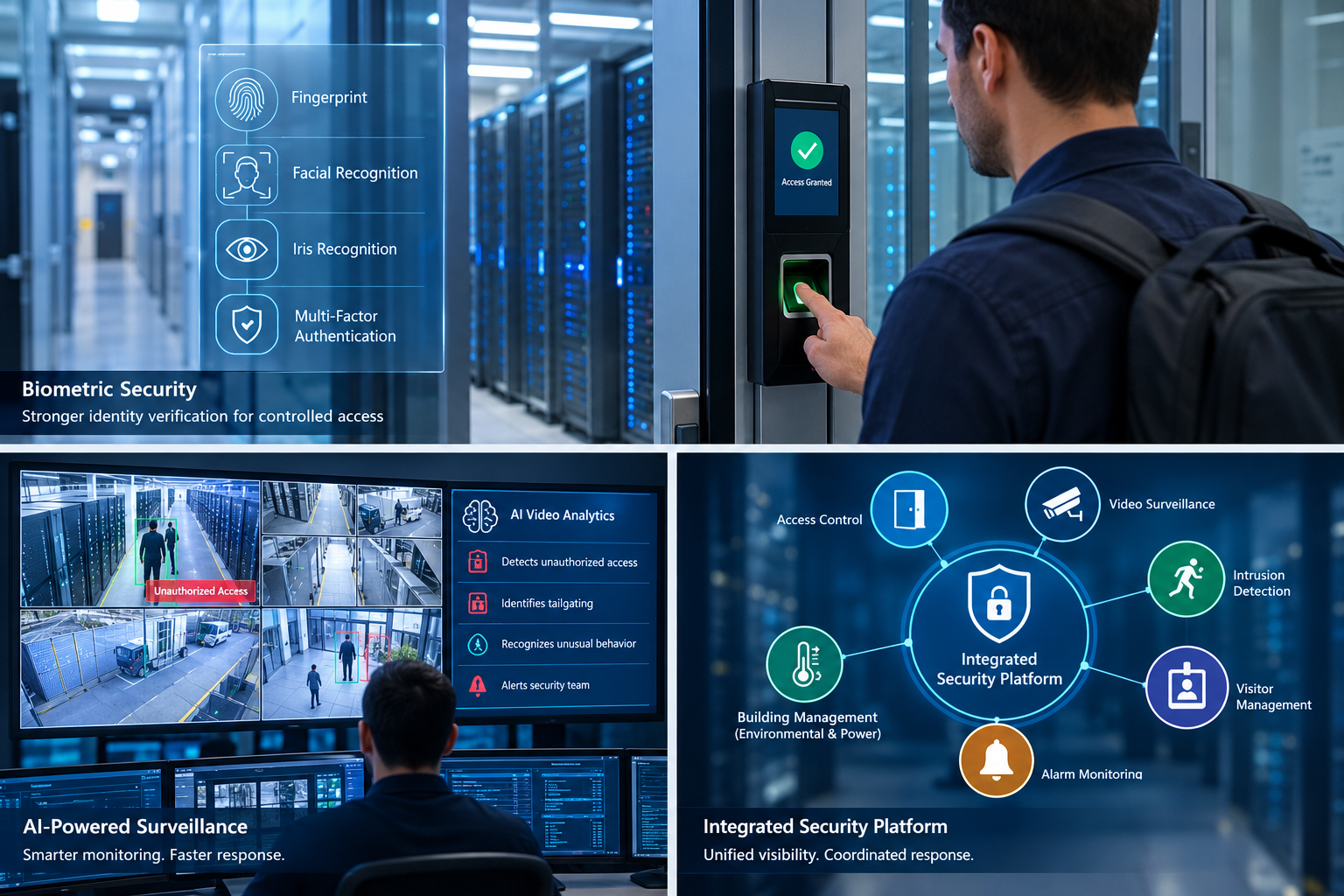
Another important trend is the integration of physical security systems into unified management platforms.
Access control, CCTV, intrusion detection, visitor management, alarm monitoring, and building management systems have often operated independently. This separation can delay investigations and make it difficult to establish a complete picture of an incident.
Integrated platforms bring relevant events together and can enable coordinated responses.
For example, when an employee's access rights are revoked, the change can be propagated to relevant doors and restricted zones. When a forced-entry alarm occurs, the system can present nearby camera feeds and access logs to the security operator.
Integration with IT service management and security operations processes can further improve incident tracking, accountability, escalation, and post-incident analysis.
Nevertheless, integration introduces its own risks. Centralized security platforms require strong authentication, network segmentation, secure configuration, restricted administrative privileges, and reliable logging. A compromised management platform could otherwise become a high-impact point of failure.
Anti-Tailgating, Smart Entry Systems, and Zero-Trust Principles
A common weakness in physical security is tailgating: an unauthorized person entering behind someone who has legitimate access.
Traditional card readers verify a credential but may not verify that only one person entered. Modern entry systems can address this weakness through mantraps, occupancy sensors, turnstiles, door-position sensors, and video analytics.
In high-security environments, anti-tailgating controls may require each person to authenticate separately and may trigger an alert when the number of people entering does not match the number of successful authorizations.
These controls complement the broader principle of zero trust: access should be explicitly authorized and continuously governed according to identity, context, and need.
In physical environments, zero-trust principles translate into several practices:
-
Verify identity at relevant security boundaries.
-
Grant only the minimum required access.
-
Restrict access by role, location, and approved time window where appropriate.
-
Reassess permissions regularly.
-
Record and investigate significant access events.
-
Revoke access promptly when authorization expires.
The goal is not to challenge every legitimate action unnecessarily, but to make unauthorized movement more difficult to conceal and easier to detect.
Protecting the Physical Infrastructure Beyond Access Doors
Physical security extends beyond entrances, badges, and cameras. Data center operators must also protect the supporting infrastructure that keeps services running.
Fire detection and suppression
Early smoke and fire detection, appropriate suppression systems, and tested emergency procedures help reduce the consequences of fire. System selection must account for electrical equipment, occupied spaces, applicable safety codes, and the specific risks of the facility.
Environmental monitoring
Sensors can monitor temperature, humidity, water leakage, and other environmental conditions. Alerts should reach responsible personnel quickly, with clear escalation procedures for critical events.
Power and cooling protection
Uninterruptible power supplies, backup generators, redundant cooling, and protected electrical distribution reduce the risk that a local failure will become a major service interruption. Their physical enclosures and access points also require appropriate protection.
Equipment and media handling
Servers, storage devices, removable media, and retired equipment should be tracked throughout their lifecycle. Secure delivery areas, inventory controls, authorized maintenance procedures, and verified media sanitization or destruction help reduce theft and information leakage.
Resilience against external events
Depending on the facility's location and risk profile, protection may also need to address flooding, extreme weather, vehicle impact, nearby construction, civil disturbances, and other external hazards.
A comprehensive physical security program therefore overlaps with business continuity, disaster recovery, safety management, and infrastructure resilience.
The Risks of Over-Reliance on Emerging Technology
Although biometrics and AI offer important benefits, their introduction creates new technical, operational, and governance challenges.
Privacy and compliance: Facial recognition and other biometric systems can process sensitive personal information. Collection, retention, access, and use should be proportionate, transparent where required, and consistent with applicable law.
False positives and false negatives: AI may flag harmless activity or fail to identify a genuine threat. Human verification, ongoing performance evaluation, and alternative detection methods remain important.
Cybersecurity of physical security systems: Cameras, biometric readers, access controllers, and security management servers are connected devices that can introduce vulnerabilities. They need secure configuration, timely updates, network isolation where appropriate, and continuous monitoring.
Vendor dependence and interoperability: Proprietary systems may complicate integration, future upgrades, and replacement. Organizations should evaluate supported standards, data portability, vendor support, and lifecycle costs.
Operational continuity: Security systems must be designed to handle power outages, communication failures, network interruptions, and component failures. Emergency egress and life safety must not be compromised by access-control design.
Governance and accountability: Organizations should establish clear policies defining who can review footage, change access permissions, investigate alerts, and approve automated actions.
The right approach is to use emerging technologies to strengthen a well-designed security program—not to substitute technology for sound procedures, competent personnel, and accountable management.
A Practical Roadmap for Improving Data Center Physical Security
Organizations do not necessarily need to deploy every emerging technology at once. A risk-based roadmap helps prioritize investment and demonstrate measurable improvement.
-
Assess the current environment. Identify critical assets, existing controls, access points, vulnerabilities, and relevant threat scenarios.
-
Strengthen foundational controls. Verify perimeter protection, access permissions, visitor procedures, camera coverage, alarm handling, and emergency arrangements.
-
Implement identity-based access. Introduce or improve role-based access control, multi-factor verification for sensitive zones, and timely access revocation.
-
Pilot biometrics where justified. Select a limited number of high-risk entry points, define privacy safeguards, test accuracy, and establish fallback procedures before expanding.
-
Introduce intelligent monitoring. Evaluate AI-enabled video analytics and access anomaly detection against specific risks, such as tailgating or unauthorized after-hours entry.
-
Integrate security information. Correlate access logs, video events, alarms, visitor records, and maintenance activities where this delivers clear operational value.
-
Test incident response. Conduct exercises covering forced entry, suspicious insider activity, lost credentials, environmental alarms, and security system outages.
-
Measure and improve. Track incidents, false-alarm rates, response times, access-review completion, and corrective actions. Review results regularly and update controls as threats evolve.
This approach helps organizations avoid investing in sophisticated technologies while leaving basic security weaknesses unresolved.
Measuring the Effectiveness of Physical Security
Security performance should be evaluated using meaningful operational indicators rather than the number of cameras installed or access cards issued.
Useful key performance indicators (KPIs) include:
-
Number and severity of unauthorized access incidents.
-
Time required to detect and acknowledge security alerts.
-
Time required to contain and resolve incidents.
-
Frequency of tailgating events and repeat access violations.
-
Percentage of access permissions reviewed on schedule.
-
Number of unresolved security vulnerabilities.
-
False-positive and false-negative rates for AI detection systems, where measurable.
-
Percentage of critical security controls tested successfully.
-
Completion rates for staff training and incident-response exercises.
These indicators should be interpreted together. For example, an increase in detected incidents may indicate deteriorating security, but it may also reflect improved detection capabilities. Performance measures should therefore be reviewed in context and used to guide corrective action.