
ITSM today is not a single framework — it’s an integrated ecosystem where ITIL manages services, SIAM integrates suppliers, COBIT governs, VeriSM guides integration, Agile/DevOps deliver speed, and USMBOK conceptually connects everything.
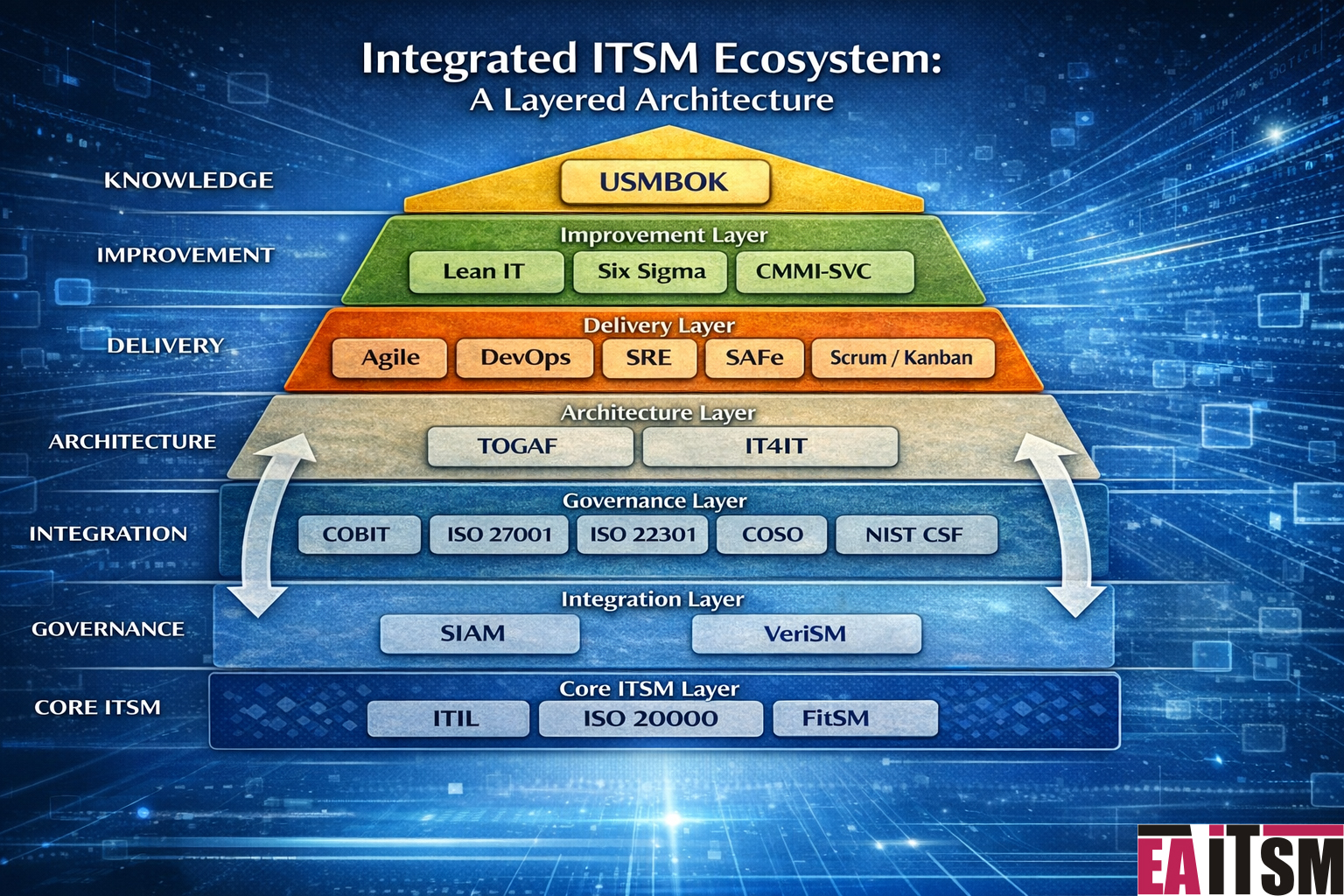
How ITSM & Related Frameworks Relate
| Framework / Model | Primary Role | How It Relates to ITSM |
|---|---|---|
| ITIL 4 | Service management practices | Core ITSM best-practice framework |
| ISO/IEC 20000 | ITSM standard | Formalizes ITSM into certifiable requirements |
| COBIT | Governance & control | Governs ITSM processes and decisions |
| SIAM | Multi-provider integration | Coordinates multiple service providers under ITSM |
| VeriSM | Digital service management | Guides how to select and combine practices |
| FitSM | Lightweight ITSM | Simplified ITSM for smaller orgs |
| MOF | IT operations | ITIL-aligned ops framework for Microsoft ecosystems |
| IT4IT | IT value chain architecture | Structures ITSM data, flows, and tooling |
| USMBOK | Knowledge integration | Conceptual map connecting all service frameworks |
| ASL | Application services | Manages application lifecycle services |
| BiSL | Business information mgmt | Bridges business demand with IT supply |
| CMMI-SVC | Service maturity model | Measures and improves service capability |
| COBIT | Governance | Ensures control, risk, and compliance (cross-cutting) |
| NIST CSF | Cybersecurity | Secures IT services |
| ISO/IEC 27001 | Information security | Secures service delivery |
| ISO 22301 | Business continuity | Ensures service resilience |
| ISO 9001 | Quality management | Improves service consistency |
| COSO | Enterprise risk | Enterprise risk integration |
| TOGAF | Enterprise architecture | Aligns IT services with business architecture |
| Lean IT | Efficiency | Removes waste in service processes |
| Six Sigma | Quality improvement | Reduces defects in service delivery |
| Agile | Adaptive delivery | Enables flexible service development |
| DevOps | Fast delivery | Integrates build + operate |
| SRE | Reliability engineering | Engineering-based service reliability |
| SAFe | Scaled agility | Enterprise-level Agile integration |
| Scrum / Kanban | Team agility | Operational agility in service teams |
| Cloud CAFs | Cloud governance & ops | Service management in cloud environments |
| ITIL 4 DITS | Digital strategy | Digital transformation alignment |
Key Takeaways
-
ITIL and ISO/IEC 20000 are the foundational and most widely used in ITSM.
-
COBIT complements ITSM by focusing on governance.
-
DevOps and Agile improve responsiveness and delivery speed.
-
Lean, Six Sigma, VeriSM, FitSM support specific organizational needs (efficiency, quality, context-based service management).
-
ITIL / FitSM / ISO 20000 → How services are managed
-
SIAM → How multiple providers are coordinated
-
COBIT / COSO / NIST → How IT is governed and controlled
-
DevOps / Agile / SRE → How services are built and improved fast
-
TOGAF / IT4IT → How IT is structured and integrated
-
Core ITSM → ITIL, ISO 20000, FitSM
-
Integration layer → SIAM, VeriSM
-
Governance layer → COBIT, ISO 27001, ISO 22301, NIST, COSO
-
Architecture layer → TOGAF, IT4IT
-
Delivery layer → Agile, DevOps, SRE, SAFe
-
Improvement layer → Lean, Six Sigma, CMMI-SVC
-
Knowledge layer → USMBOK
Practical Note
No single framework does everything — mature organizations blend several.
If someone says:
“We use ITIL + SIAM + COBIT + DevOps”
That’s not overkill — that’s actually normal for large or modern organizations.