
The launch of ITIL Version 5 in early 2026 represents a major milestone in the evolution of IT Service Management. Designed for the complexities of AI-augmented, multi-provider, and digitally decentralized organizations, ITIL 5 strengthens the integration of Digital Product Management and Digital Service Management while preserving the practical foundation of proven practices.
Digital Products vs. Digital Services
ITIL 5 provides precise definitions and tight integration:
- Digital Product: A versioned, configurable bundle comprising infrastructure, applications, middleware, data platforms, APIs, and supporting components. It is the tangible technical foundation.
- Digital Service: The value-realizing mechanism that leverages one or more digital products to deliver business outcomes, user experiences, and measurable results.
This distinction eliminates historical silos and enables end-to-end accountability across product and service lifecycles.
Unified Product-Service Lifecycle
One of the most significant shifts is the reintroduction of a single, shared lifecycle used by both Product and Service Management teams. It typically features eight key activity areas (expanded and more flexible than ITIL 4’s six-element Value Chain):
- Discover / Opportunity Identification
- Design
- Build / Acquire
- Integrate / Configure
- Deploy / Transition
- Operate / Deliver
- Support / Optimize / Improve
- Retire / Sustain
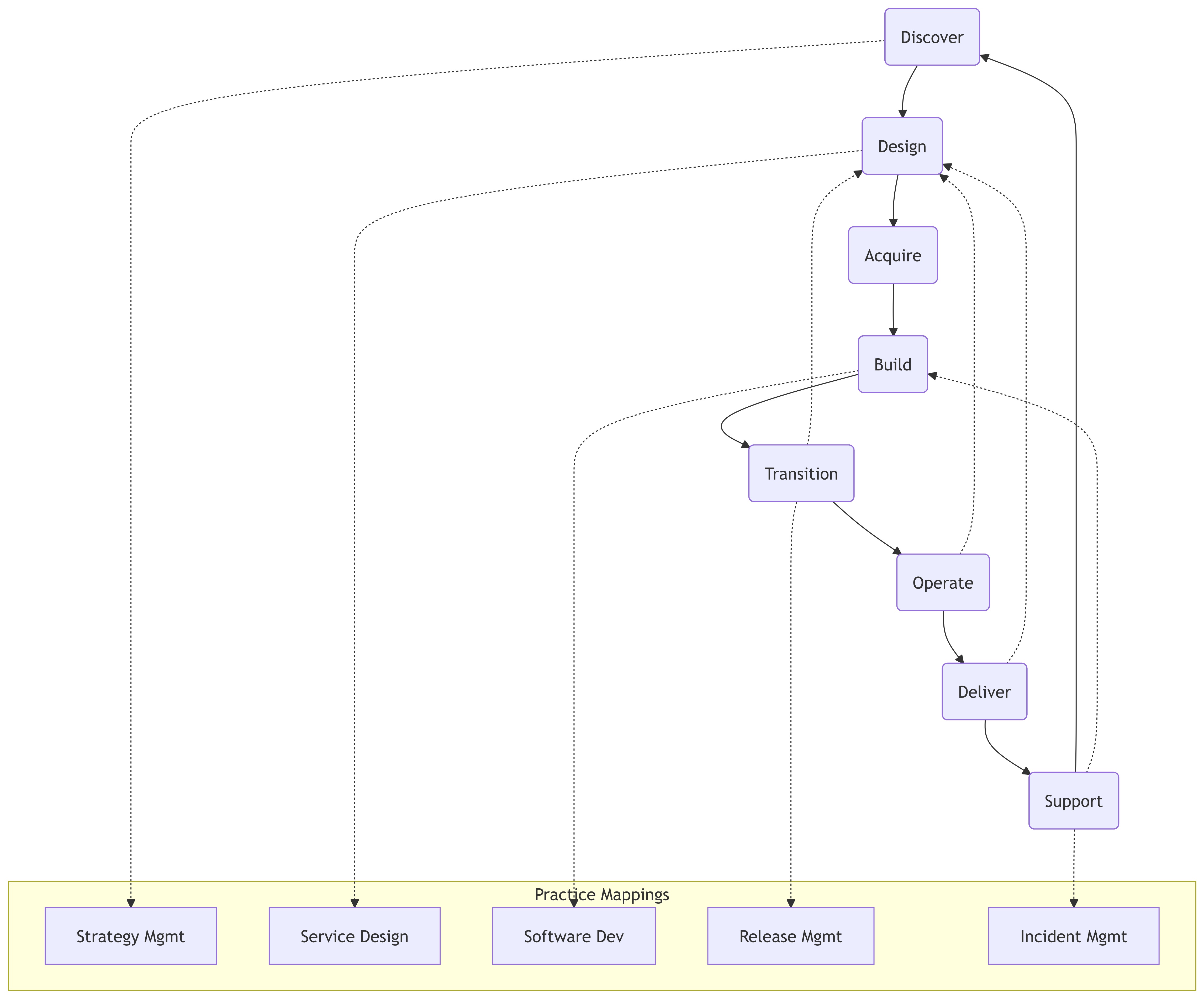
Technical Advantage: Practices are mapped explicitly to activities within each stage rather than being confined to specific phases. This supports iterative, AI-enabled workflows where development, operations, testing, and optimization occur in highly compressed or parallel loops.
Enhanced Service Level Management (SLM)
Traditional Utility (what the service does) and Warranty (how well it performs) are now expanded to a four-pillar model:
- Utility
- Warranty
- Experience — Usability, emotional resonance, friction reduction, and journey quality.
- Sustainability — Long-term technical debt management, cost predictability, environmental impact, and ongoing consumability.
This richer model is particularly valuable for GRC and Risk professionals assessing control effectiveness and service resilience.
The ITIL Value System
The Service Value System evolves into the broader ITIL Value System, explicitly supporting both product and service perspectives. Its components are:
- Guiding Principles (7 principles from ITIL 4, now with detailed step-by-step implementation guidance and practical workflows).
- Value Chain — End-to-end activities from opportunity to value realization.
- Management Practices — The 34 practices remain largely stable (updated on a rolling basis with dates, not version numbers).
- Continual Improvement (integrated throughout).
- Governance (strengthened for multi-provider and AI contexts).
Value Stream Orchestration
ITIL 5 emphasizes mapping and orchestrating enterprise value streams that often span internal units, external partners, and business-led digital initiatives. Organizations are guided to identify which lifecycle activities they retain accountability for versus those they outsource, while maintaining visibility and control.
Example: "AI-Powered Customer Onboarding"
This value stream connects a Business Unit (Sales), Internal IT, and an External SaaS Partner to deliver a seamless onboarding experience.
Goal: Reduce onboarding time for new enterprise clients from 30 days to 2 days using AI.
1. Engage & Plan (Business Units + External Partner)
• Step: Sales (Business Unit) identifies a new client and triggers the onboarding workflow.
• Action: The CRM triggers an automated notification to the external SaaS provider's API.
• ITIL Activity: Engage / Plan.
• Outcome: Demand is registered, and the external partner's system generates a personalized onboarding plan.
2. Design & Transition (Internal IT + External Partner)
• Step: Internal Security team and the external partner map the data flow and security protocols.
• Action: AI-based compliance checker validates the integration configuration against current regulations.
• ITIL Activity: Design & Transition.
• Outcome: Compliant integration configuration approved.
3. Obtain & Build (External Partner + Internal IT)
• Step: The external partner deploys the SaaS platform instance via automated pipelines (CI/CD).
• Action: Internal DevOps team validates the API connectivity.
• ITIL Activity: Obtain & Build.
• Outcome: Service component activated and integrated.
4. Deliver & Support (Internal Service Desk + Partner Support)
• Step: The client initiates the first session.
• Action: If an error occurs, AI diagnostic tools automatically determine if it is a local network issue (Internal IT) or a SaaS platform error (External Partner), routing the ticket automatically.
• ITIL Activity: Deliver & Support.
• Outcome: Service operational, with co-created support.
5. Improve (All Stakeholders)
• Step: Weekly review of experience metrics (e.g., NPS) and performance data, spanning internal teams and external partner data.
• Action: Adjusting the AI model for better future onboarding performance.
• ITIL Activity: Improve.
• Outcome: Continual improvement of the service experience.
Key Characteristics of this ITIL 5 Value Stream
• Crosses Organizational Boundaries: Involves Internal Sales, Internal IT, and External Software Supplier.
• AI-Native: Uses AI for validation, diagnosis, and routing.
• Value Co-Creation: Value is not just delivered; it is co-created by the partner's platform and the user's experience.
• End-to-End: Covers the entire journey from "Sales Signed" to "Customer Enabled," not just the IT technical steps.