
For years, the Internet of Things (IoT) has promised a hyper-connected world. Millions—now billions—of smart devices, sensors, and appliances were deployed to gather real-time operational data. However, raw data alone isn't inherently useful. Without efficient methods to parse, analyze, and act upon this vast influx of information, many connected networks faced severe bandwidth bottlenecks and data overload.
Enter Artificial Intelligence of Things (AIoT). By blending AI's analytical power with IoT's connectivity infrastructure, devices are evolving from passive data gatherers into proactive, autonomous decision-makers.
What Happens When AI Meets IoT?
Traditional IoT acts as the nervous system, using sensors to sense and transmit environmental feedback. AI serves as the brain, interpreting patterns, analyzing context, and taking targeted actions without requiring constant human intervention.
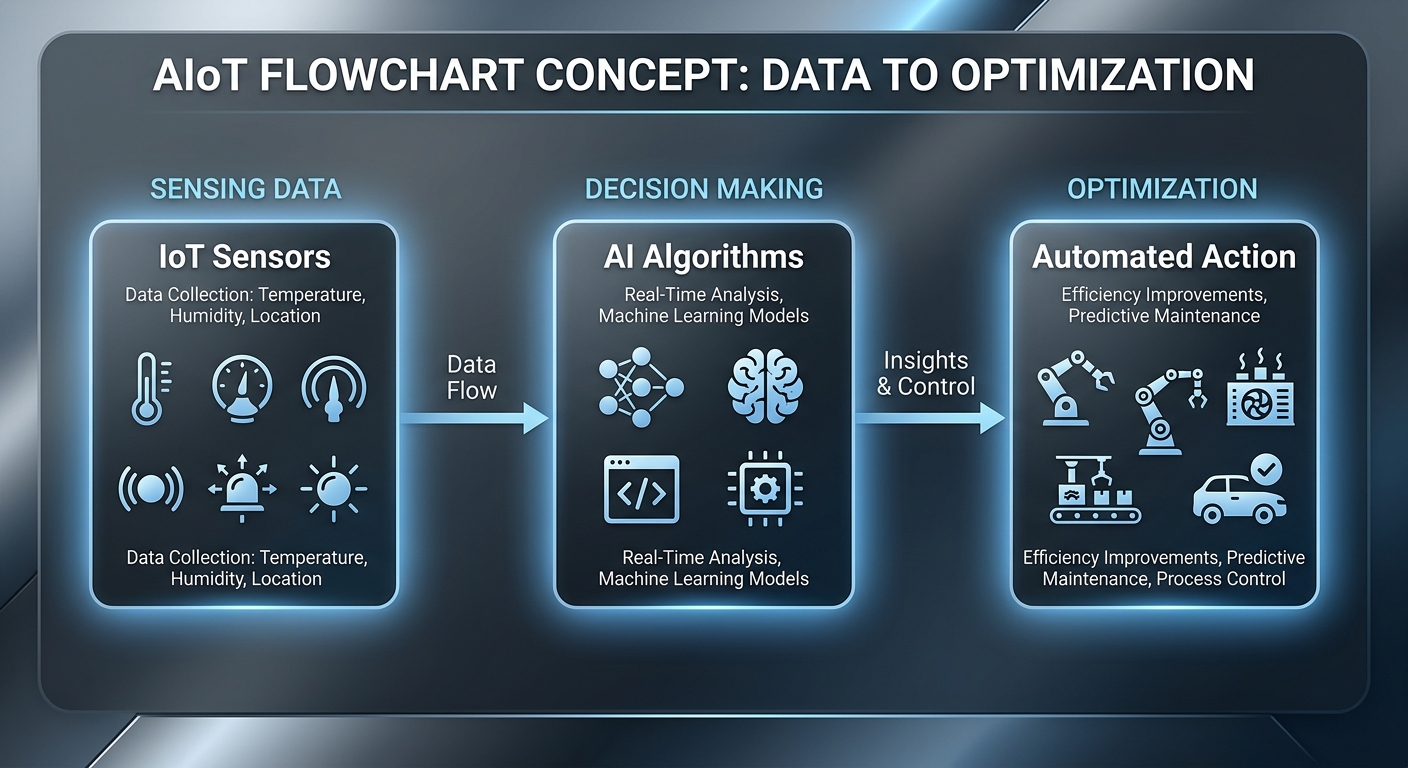
This integration unlocks key advantages across operational frameworks:
-
Edge AI Computing: Processing data locally on devices rather than routing everything back to distant cloud servers drastically lowers latency, conserves network bandwidth, and mitigates privacy risks.
-
Predictive Analytics: Instead of merely responding to equipment failures, machine learning models evaluate operational wear and tear to prevent breakdowns before they occur.
-
Real-Time Network Security: AI continuously monitors system context to detect abnormal traffic patterns, dynamically shielding infrastructure against cyber threats.
Primary AI Applications in the IoT Arena
1. Smart Manufacturing & Industry 4.0
In industrial environments, equipment downtime can cost millions per hour. AIoT leverages vibration, temperature, and pressure sensors paired with deep learning to deliver continuous system health assessments.
-
Predictive Maintenance: Algorithms spot subtle mechanical anomalies well ahead of critical mechanical failures.
-
Quality Assurance: Vision AI models running on edge processors scan production lines to instantly identify structural or cosmetic product defects.
2. Smart Cities and Infrastructure
Metropolitan areas are deploying AIoT ecosystems to optimize resource allocation, reduce congestion, and bolster safety.
-
Dynamic Traffic Management: AI systems analyze real-time video feeds from road sensors to dynamically adjust traffic light cycles, alleviating gridlock and reducing emissions.
-
Smart Energy Grids: Machine learning models anticipate demand spikes by analyzing climate data and historic consumption patterns, balancing supply autonomously.
3. Healthcare & Remote Monitoring
Connected medical devices paired with AI offer non-invasive, round-the-clock patient tracking.
-
Wearable Patient Monitors: Medical-grade wearables track vital signs in real time, alerting clinical teams instantly if irregular heart rhythms or oxygen drops occur.
-
Hospital Asset Tracking: Smart tags combined with predictive AI track critical inventory like ventilators and surgical equipment, ensuring availability during emergencies.
4. Smart Homes & Sustainable Buildings
Consumer AIoT extends beyond basic voice commands to create truly adaptive living environments.
-
Energy Optimization: Smart thermostats learn resident routines and track real-time occupancy to automatically adjust HVAC settings, cutting power waste.
-
Adaptive Security Systems: AI-powered cameras distinguish between family members, pets, and unauthorized intruders, reducing false alarm rates.
Essential Architectural Approaches
| Approach | Ideal Use Case | Primary Advantage | Key Challenge |
| Edge AI Processing | Autonomous vehicles, industrial safety systems | Near-zero latency and reduced bandwidth consumption | On-device hardware constraints |
| Cloud-Based Analytics | Cross-region supply chain tracking, historical trend analysis | Scalable storage and vast compute capabilities | Higher latency and network bandwidth usage |
| Hybrid Edge-Cloud | Enterprise smart grids, smart hospital operations | Balanced real-time responsiveness with centralized deep training | Architectural complexity |
Overcoming Key Implementation Challenges
While the benefits of AIoT are significant, deployment brings real-world technical obstacles:
-
Hardware & Compute Constraints: Many small IoT devices operate on tight power budgets and minimal processing capacity. Solution: Deploying lightweight, specialized neural network architectures (e.g., TinyML) tailored for microcontrollers.
-
Interoperability Standards: Devices produced by different manufacturers frequently utilize disjointed protocols. Solution: Adopting open communication frameworks and standardized data schemas.
-
Cybersecurity & Data Privacy: Distributed networks create expanded attack surfaces for cyber incidents. Solution: Implementing hardware-level secure enclaves and AI-driven automated incident response frameworks.
The convergence of artificial intelligence and connected hardware represents a permanent shift in how physical operations are managed. Moving forward, the value of the IoT ecosystem will no longer be measured merely by how many devices are connected, but by how intelligently those devices process information to solve real-world problems.